

Chain Conveyor
A conveyor that moves powder and granular raw materials from one point to another with a chain and carriers inside an enclosed casing; the newest addition to Erk’s conveying range.
Highlights
What is a chain conveyor?
A chain conveyor is a mechanical conveying system that moves powder and granular material with a chain and attached carriers running inside an enclosed casing. The material travels as a mass without being mixed with air, which keeps dust at the source and lowers the risk of blends segregating.
Erk PVC Makine has added the chain conveyor to its feeding and conveying range. Together with the flexible screw conveyor, it gives a second mechanical option for the conveying steps from raw material intake to extruder feeding. The video on this page shows our chain conveyor moving powder.
Where is it used?
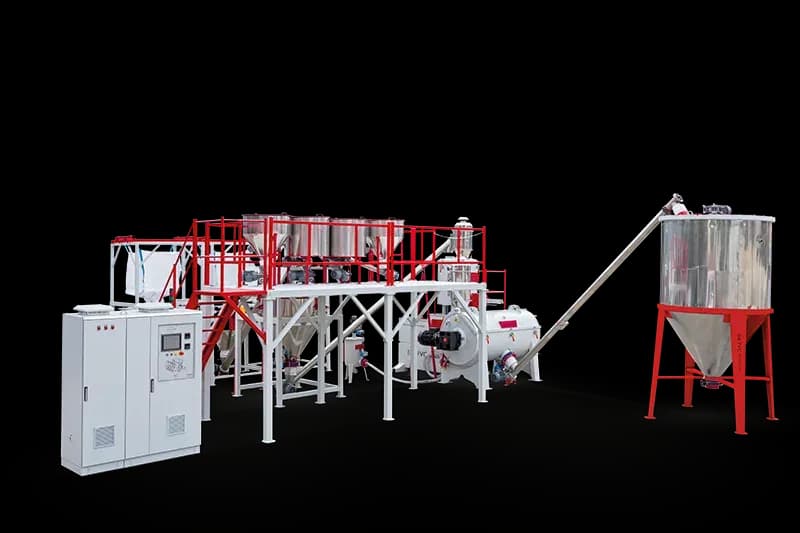
- Raw material intake: from a big bag discharge station to silos or buffer hoppers.
- Silo to dosing: transferring stored raw material to automatic powder dosing hoppers.
- After the mixer: carrying dry blend from the cooler to a silo or buffer hopper.
- Several destinations: feeding more than one discharge point along a route.
Chain conveyor or flexible screw?
Criterion | Chain conveyor | Flexible screw |
|---|---|---|
Principle | Chain and carriers in an enclosed casing | Shaftless spiral turning in a flexible tube |
Route | Fixed route designed for the plant | Short to medium distances, as the flexible tube allows |
Typical job | Raw material intake, transfer between silos and hoppers | Feeding from a hopper to the extruder hopper |
In common | Enclosed, dust-free, mechanical conveying | Enclosed, dust-free, mechanical conveying |
The right choice is made with you, based on the material, quantity, distance and the horizontal and vertical sections of the route. For a comparison with pneumatic conveying, see vacuum conveying of powders.
Benefits
- Dust-free operation: the enclosed casing keeps dust out of the plant.
- Blends stay intact: material moves without being mixed with air, so blends such as dry blend are less likely to segregate.
- Less manual work: no more moving raw material by bucket and by hand.
- One line: the conveyor is designed in the same layout as stations, silos, dosing and mixers.
Information for a quotation
- Materials to convey (powder, granules, blends) and their approximate bulk densities
- Hourly conveying demand
- Positions and heights of inlet and outlet points and the route between them
- Abrasiveness (for example high calcium carbonate content) and moisture condition
Chain conveyors are built at our factory in Ergene, Tekirdağ; installation, commissioning, operator training, remote support and spare parts are provided. Send us your layout drawing and material details and we will define the right conveying solution with you.
Downloads
Frequently Asked Questions
What materials can a chain conveyor carry?
Powder and granular materials such as PVC resin, fillers like calcium carbonate, dry blend and granular raw materials. Suitability is assessed from the material’s flow behaviour, abrasiveness and moisture condition.
What is the difference between a chain conveyor and a flexible screw conveyor?
Both convey mechanically and enclosed. A chain conveyor moves material with a chain and carriers in a closed casing; a flexible screw moves it with a shaftless spiral turning in a flexible tube. The choice depends on material, quantity and route.
How far can a chain conveyor convey?
Distance depends on the material, the required quantity and the route. Send us your layout drawing and material details and we will design the route and conveyor with you.
Can a chain conveyor be added to my existing line?
In most cases, yes. We review your existing silo, hopper and mixer connection points on site or from drawings and engineer the conveyor around them.
Get a Quote
Request a Quote
Fill in the form and our sales engineers will get back to you within one business day.