

Feeding & Conveying
Dust-free, loss-free transfer of powder and granules from mixer to silo and extruder hopper.
 Big Bag Discharge StationA station that empties PVC resin, calcium carbonate and other powder raw materials from big bags in a controlled, dust-free way into silos, dosing hoppers or conveying lines.
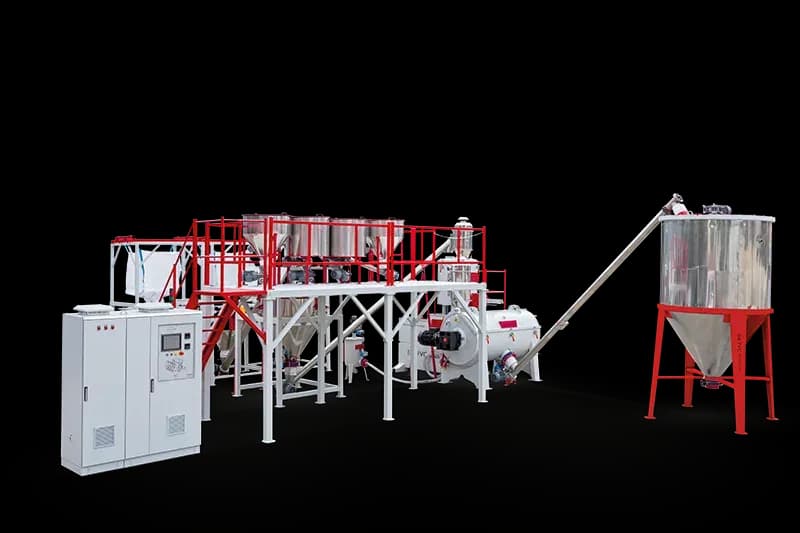 Chain ConveyorA conveyor that moves powder and granular raw materials from one point to another with a chain and carriers inside an enclosed casing; the newest addition to Erk’s conveying range.
- Tubular Screw ConveyorA rigid screw conveyor that moves powder and granules horizontally or on an incline with a flight turning on a shaft inside a closed tube; from below silos to hopper and mixer feeding.
- U-Trough Screw ConveyorA screw conveyor that moves, collects and distributes powder and granular material horizontally with a flight turning on a shaft inside a U-shaped trough.
- Screw FeederA short screw that feeds powder and granular material from a hopper into a scale, a mixer or the next machine at a controlled rate; the feeding element of gravimetric dosing.
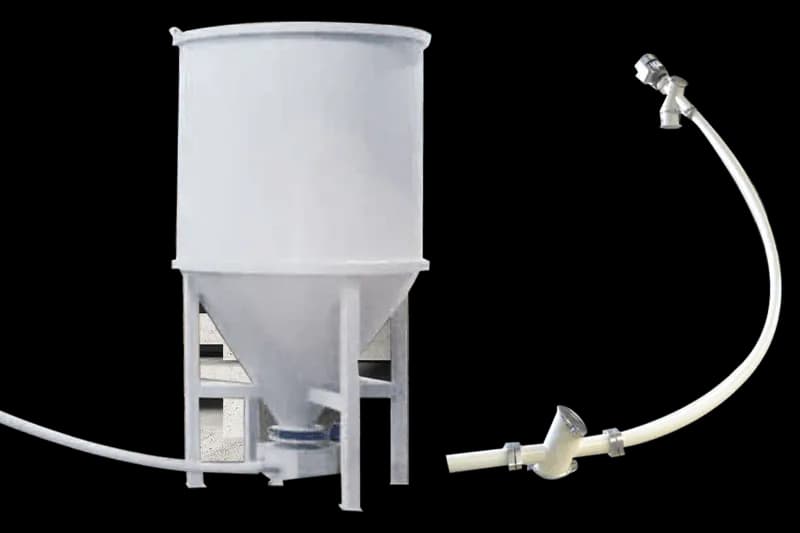 FlexconFlexible Screw Conveyor (Flexcon)A flexible screw conveyor that moves powder and granules point to point inside a closed tube without loss, feeding mixers, dosing units and extruder hoppers at a steady rate.
Why extruder feeding matters
A well-prepared dry blend can still be spoiled on its way to the extruder. Open handling causes dust and material loss; irregular feeding lets the hopper run low, makes extruder load fluctuate and pushes product quality off target. Manual transfer adds labour and the risk of foreign matter.
An extruder feeding system moves the blend from one point to the next inside a closed line, continuously and under control, so the homogeneity achieved in the mixer is preserved all the way to the extruder hopper.
Where it fits in the line
Erk PVC Makine does not build extruders; we design and install the whole line in front of the extruder. Feeding and conveying connect the links of that chain:
- Dosing: raw materials are weighed to the recipe by automatic dosing systems.
- Mixing: the weighed batch becomes dry blend in a hot-cold PVC mixer.
- Conveying: the cooled blend is transferred by screw to a silo, a buffer hopper or directly down the line.
- Sieving: where required, a powder sieve removes lumps and foreign matter.
- Extruder feeding: the finished material is fed into the extruder hopper.
Conveyors are used not only after the mixer but also to feed raw materials into dosing units and mixers.
Flexible screw conveyor (Flexcon)
The flexible screw conveyor moves powder and granules with a spiral rotating inside a flexible tube. It is also known as a spiral conveyor or flexible auger.
Key features:
- Dust-free, loss-free transfer: the material travels inside a closed tube, so there is no dust and no spillage.
- Versatile: feeds mixers, dosing units, silos and extruders.
- Horizontal and vertical conveying: the flexible design adapts to different layouts and height differences.
- Built for abrasive powders: can be made with wear-resistant alloys for abrasive materials such as calcium carbonate.
Screw conveyors: four types, one manufacturer
Erk PVC Makine builds four types of screw conveyor for powder and granules. Besides PVC lines, our screw conveyors are used to convey powder and granular materials in other industries.
Screw type | Design | Typical use |
|---|---|---|
Shaftless spiral turning in a flexible tube | Curved routes, extruder hopper and mixer feeding | |
Shafted flight in a closed tube | Below silos, horizontal and inclined conveying, high throughput | |
Shafted flight in a U-shaped trough | Horizontal conveying, collecting and distributing, easy maintenance | |
Short feeder screw running at controlled speed | Feeding scales, mixers and hoppers |
Which type suits you is explained in types of screw conveyor and flexible or rigid screw conveyor?. To work out throughput with your own figures, use the calculator on our screw conveyor capacity calculation page.
Which conveying method?
Need | Best fit |
|---|---|
Hopper to extruder hopper, curved route | |
Below a silo, horizontal or inclined, high throughput | |
Horizontal collecting and distributing | |
Controlled feeding of a scale or hopper | |
Raw material intake, between silos and hoppers | |
Raw material delivered in big bags | |
Long routes with many points | Pneumatic (vacuum) conveying, see vacuum conveying of powders |
What closed conveying brings to production
Closed screw conveying does more than keep the floor clean; it improves production itself:
- Material savings: no spillage or dust means less raw material lost.
- Less labour: carrying sacks and filling hoppers by hand become automatic.
- Quality assurance: a closed line reduces the risk of foreign matter and preserves the homogeneity achieved in the mixer.
- Operator health: lower dust exposure makes the workplace safer.
Directly on the mixer, the EPM-JET filter and dehumidifier controls moisture and dust, so the material you convey is right from the start.
Choosing the right feeding system
When we engineer a feeding line, these points decide the design:
- The material being conveyed (dry blend, powder additive, granules) and how abrasive it is
- Hourly demand and the number of machines to be fed
- Horizontal distance, height difference and plant layout
- Pick-up and discharge points (mixer, silo, hopper)
With this information we choose the conveyor configuration with you. To map your whole line step by step, use our line configurator.
Installation and support
Our feeding systems are engineered in the same project as our mixers and dosing equipment, so connection points and controls fit from the start. With experience in more than 46 countries, we handle installation, commissioning and training on site, followed by remote support and spare parts. See application examples under industries.
For an extruder feeding system that fits your line, request a quote.
Frequently Asked Questions
What is a flexible screw conveyor?
A flexible screw conveyor moves powder and granules with a spiral rotating inside a flexible tube. Because the material stays inside a closed line, there is no dust and no material loss. It is also called a spiral conveyor or flexible auger.
What can a flexible screw conveyor feed?
It can feed mixers, dosing units, silos and extruder hoppers. It is used both to transfer raw materials into a mixer or dosing unit and to carry finished dry blend to the extruder.
Can it convey vertically?
Yes. Thanks to its flexible design, the conveyor handles both horizontal and vertical runs and adapts to different plant layouts and height differences. The right configuration is chosen for your layout.
Can it handle abrasive powders such as calcium carbonate?
Yes. For abrasive powders the conveyor can be built with wear-resistant alloys. Tell us your material and filler level so we can choose the right construction.
Does Erk PVC Makine also build extruders?
No. Erk PVC Makine does not build extruders. We design and install the complete line in front of the extruder: dosing, mixing, conveying, sieving and extruder feeding. Our feeding systems are engineered to work with extruders from other manufacturers.