

Knowledge Hub

Screw conveyor capacity calculation: formula, example and calculator
How much a screw conveys per hour depends on a handful of geometric and operating variables, the bulk density of the material and the incline. The formula, a worked example and a calculator for your own figures.
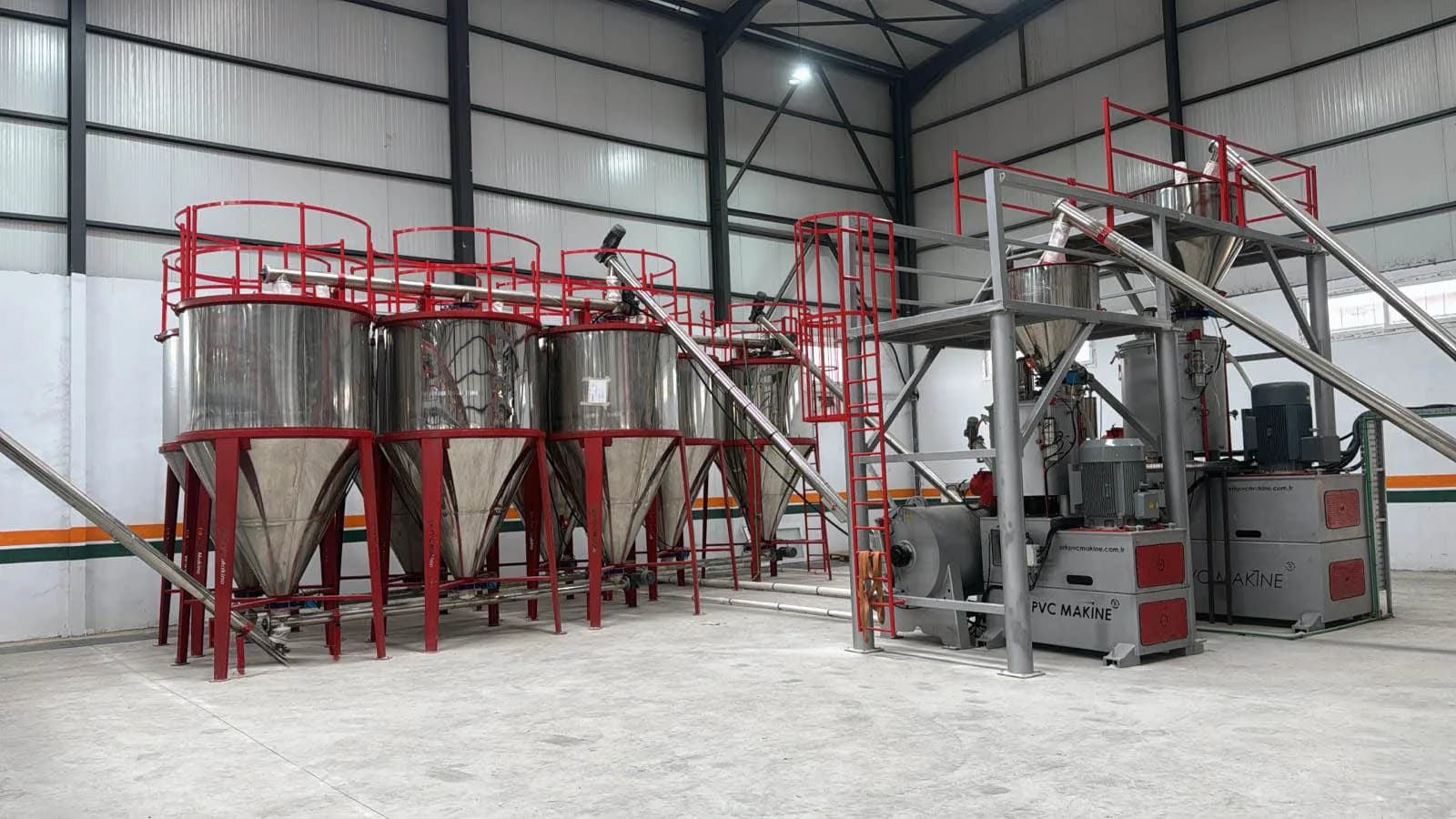
Flexible or rigid screw conveyor? Which one, and when?
Both convey powder and granules, but one is strong on curved routes and the other on straight, high-throughput lines. The differences, where each fits in a PVC line and a decision checklist.

Types of screw conveyors: which screw goes where?
Tubular, U-trough, flexible and feeder screws work on the same principle but are built for different jobs. Their design, strengths and selection criteria in one table.
How to read a PVC formulation: phr and additive groups
PVC formulations are written in phr, not percentages. What phr means, what the additive groups do and how to convert a formulation into kilograms for a mixer batch.

Powder dosing problems: bridging, load-cell drift and inaccurate weighing
Most dosing problems start not in the scale but in how the material leaves the hopper and how weighing is set up. The most common problems, their symptoms and how to deal with them.

Powder separation in plastics processing: which dust, which method?
Fines in granules, lumps in dry blend and dust in conveying air are different problems, and each needs its own separation method. The methods, where they belong in the line and what to ask before choosing equipment.

Vacuum conveying of powders in plastics plants: when is it the right choice?
Vacuum conveying moves powder through a closed line, dust-free and without manual handling. How it works, its components, how it differs from a flexible screw conveyor and what to watch in PVC lines.
What is PVC dry blend and how is it made?
Dry blend is the free-flowing powder that turns PVC resin into extruder-ready feedstock. This guide covers the ingredients, the hot-cold mixing process, quality criteria and the equipment that makes up a dry blend line.

What is a turbo mixer and how does it work?
A turbo mixer is the high-speed heating mixer that turns PVC resin and additives into free-flowing dry blend using frictional heat. Here is how it works, why it is paired with a cooler and what to look at when choosing one.

What is an automatic dosing system and what does it change?
An automatic dosing system weighs every powder and liquid in a PVC recipe and charges the hot mixer without manual handling. Here is how it differs from manual weighing, what it is made of and what it changes in a plant.
Gravimetric vs volumetric dosing: what is the difference?
Volumetric dosing measures by volume, gravimetric dosing by mass. Here is what that difference means for dry blend quality, waste and traceability, and how to choose between them for a PVC line.
What is a liquid dosing system? Plasticiser dosing in PVC
In flexible PVC the plasticiser can be one of the largest components of the batch. Here is why liquids should be weighed rather than metered by volume, when they go into the hot mixer and how temperature and viscosity affect dosing.
What is dosing? Precision dosing in industrial production
Dosing means feeding every ingredient of a recipe into the process in the right amount and the right order. Here is how powder and liquid dosing, the main measuring methods and the link to the mixer work on a PVC mixing line.

Horizontal or vertical cooler mixer: which suits your line?
In a PVC hot-cold mixer the heater works the same way either way; the difference is the cooler. We compare horizontal and vertical coolers on output, layout, cooling and maintenance, with a practical checklist.

What is PVC? Properties, types and applications
PVC is one of the most widely used plastics in the world, yet the resin cannot be processed on its own. This guide covers its structure, grades, K-value, why it always needs a formulation and mixing, and where it ends up.
How is PVC made? From raw material to product
Making a PVC product happens in two separate stages: a petrochemical plant produces the resin, and a converter turns that resin into a product through a formulation. Here are both stages, step by step.

What should the temperature profile of a PVC hot mixer look like?
Dry blend quality is decided along the temperature curve in the heating mixer. Here is what happens at each stage, how to set the discharge temperature and what makes cycles longer than they should be.

How do you calculate PVC mixer capacity?
The hourly output of a hot-cold PVC mixer is batch size multiplied by batches per hour. We walk through the formula, the factors that move it and two worked examples based on the EPM-H and EPM-V series.
How do you choose a flexible screw conveyor?
Material flow behaviour, feed rate, route, abrasion and level control at the hopper: the criteria that matter when you select a flexible screw conveyor for a PVC line, and what to send your supplier.
In what order should additives go into a PVC mixer?
The same formulation gives a different dry blend depending on when each additive enters the hot mixer. Here are the typical sequences for rigid and flexible PVC, and the reasons behind them.

What is metallic bonding in powder coating?
Bonding fixes metallic and pearlescent pigment to powder coating particles at a controlled temperature. How it differs from dry blending, how the process runs, the faults to avoid and where it fits in the line.
PVC dry blend problems: lumps, poor flow, low bulk density and discolouration
Dry blend problems usually show up at the extruder, but they start in the mixer. Here are the four most common ones, their likely causes and what to check first.

Why remove moisture from a PVC mixer, and how does a jet filter work?
Steam released in a heating mixer that falls back into the blend comes back as lumps, poor flow and surface defects. Where the moisture comes from, how a pulse-jet filter works, how it is sized and maintained.

Why do mixer blades wear, and how does calcium carbonate speed it up?
In highly filled PVC recipes, turbo mixer blades wear constantly, and the effect creeps into dry blend quality. Here are the signs, the causes and what to check at each maintenance stop.

Should you buy a used or a new PVC mixer?
A used hot-cold mixer can be a sound investment under the right conditions and an expensive problem under the wrong ones. The real advantages, the risks, what to inspect before you buy and how total cost compares.