

Erk PVC Makine engineering teamUpdated:
Gravimetric vs volumetric dosing: what is the difference?
Volumetric dosing measures by volume, gravimetric dosing by mass. Here is what that difference means for dry blend quality, waste and traceability, and how to choose between them for a PVC line.

Contents9
- 1What is the difference between gravimetric and volumetric dosing?
- 2How volumetric dosing works
- 3How gravimetric dosing works
- 4Side-by-side comparison
- 5Why PVC formulations favour gravimetric dosing
- 6What affects accuracy in a gravimetric system?
- 7When is volumetric dosing good enough?
- 8Questions to ask before choosing a dosing system
- 9Conclusion
What is the difference between gravimetric and volumetric dosing?
Volumetric dosing measures material by volume, for example by turning a screw a set number of times or filling a chamber. Gravimetric dosing weighs the material directly and stops feeding when the target mass is reached. The key difference: a volumetric system assumes the bulk density of the material is constant, while a gravimetric system does not need that assumption.
PVC formulations are written as mass ratios, usually phr (parts per hundred resin). What matters for recipe accuracy is therefore not the volume going into the mixer but its mass.
How volumetric dosing works
A volumetric feeder typically uses a screw, a rotary valve or a vibratory tray. It is calibrated on the basis of "one revolution moves this much volume" and runs for the number of turns or the time that corresponds to the target quantity.
Advantages:
- Simple mechanics and easy commissioning
- Low initial investment
- Good enough for materials with stable density and steady flow
Limitations:
- Errors grow when bulk density changes. The same volume holds more mass when powder is damp or compacted and less when it is aerated.
- Calibration drifts. Screw wear, changing hopper level and lot-to-lot variation all shift the result over time.
- The actual quantity is unknown. The system knows how far it turned, not how much it delivered, so traceability is weak.
How gravimetric dosing works
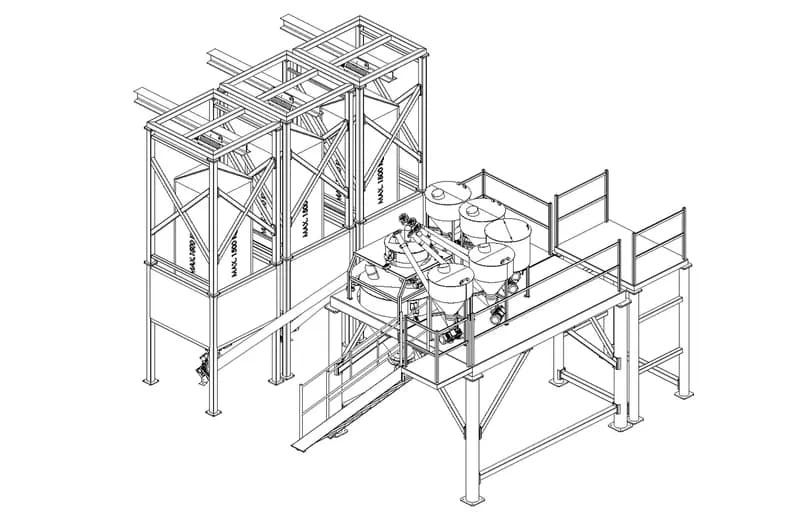
In a gravimetric system material is fed into a weigh hopper mounted on load cells. The controller reads the mass continuously, slows the feed as the target approaches and stops it at the target. It then moves on to the next ingredient, and the completed batch is discharged into the mixer.
Two gravimetric approaches are common in PVC processing:
- Batch weighing: for each batch the ingredients are weighed in sequence in one or more weigh hoppers. Because a hot-cold mixer works batch by batch, this is the natural fit for dry blend lines.
- Loss-in-weight feeding: the feeder tracks the drop in its own weight to deliver a continuous mass flow. It is mainly used to feed continuously running extruders or compounding lines directly.
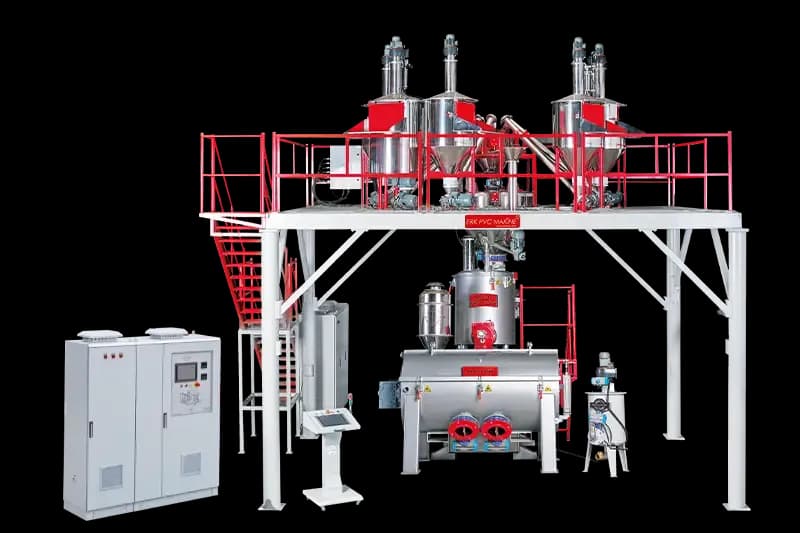
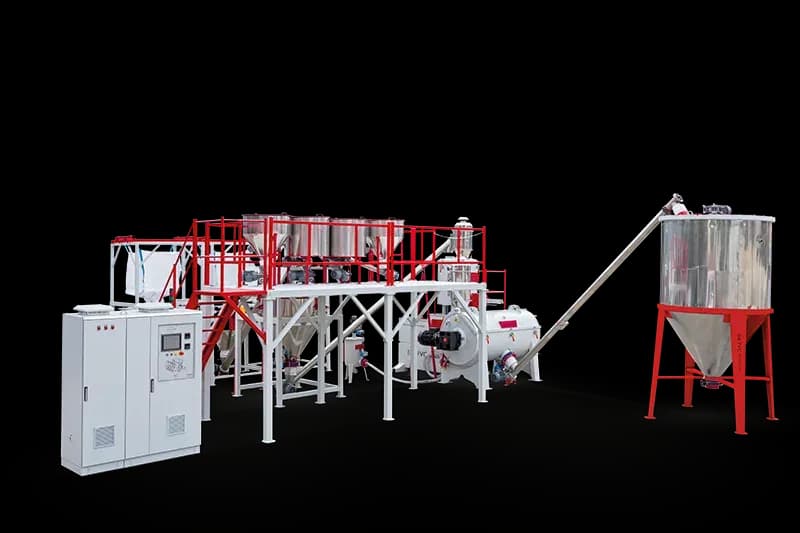
Erk PVC Makine's automatic powder dosing system uses gravimetric batch weighing: the operator selects a stored recipe, each raw material is weighed by mass and the batch is charged to the hot mixer hands-free.
Side-by-side comparison
Criterion | Volumetric | Gravimetric |
|---|---|---|
What is measured | Volume (turns, time) | Mass |
Sensitivity to bulk density | High | Low |
Record of actual quantity | Indirect | Direct |
Calibration effort | Frequent | Less frequent, scale checks |
Initial cost | Lower | Higher |
Typical use | Single ingredient, stable material | Multi-ingredient recipes |
Why PVC formulations favour gravimetric dosing
Raw materials with variable density
The bulk density of fillers such as calcium carbonate can vary between lots and with moisture. PVC resin that has been conveyed pneumatically also settles differently in the silo. In a volumetric system each of these shifts turns straight into a recipe error.
Small but critical additives
Stabilisers and lubricants are a small share of the recipe but have a large effect. Too little stabiliser shows up as burning and discolouration in the extruder; an unbalanced lubricant package causes fusion problems. For these additives a small volume error is a large error in relative terms.
Liquids
In flexible PVC, the density and viscosity of plasticisers and liquid stabilisers change with temperature, so the same volume weighs differently in winter and summer. An automatic liquid dosing system weighs the liquid and removes this effect, and it can run from the same recipe as powder dosing.
Traceability
A gravimetric system knows, and can log, the actual weight in every batch. When a customer complaint arrives, that record is what lets you trace exactly what went into the batch in question.
What affects accuracy in a gravimetric system?
Gravimetric dosing is not a guarantee by itself; the system has to be designed properly. The main factors are:
- Matching the weigh hopper to the quantity: a large hopper is relatively less precise when weighing small amounts. Large ingredients such as resin and filler and small ones such as stabiliser and pigment are therefore often handled in separate weighing arrangements.
- Coarse and fine feeding: if the feeder does not slow down near the target, material still falling through the air pushes the weight past it. Two-stage feeding reduces this overshoot.
- Material flow: powders that bridge or stick make feeding erratic, so silo cones, flow aids and the right feeder type all matter.
- Environment: vibration, air currents and flexible connections touching the weigh hopper can disturb the reading, so mounting details need to be right from the start.
For this reason a target tolerance is set for each ingredient during the project phase and the system is designed around it.
The economics
A gravimetric system costs more up front than a volumetric feeder. But the comparison should not stop at the machine price. Once you count the value of a rejected batch, wasted raw material, lost extruder time and the cost of customer complaints, the picture usually changes for multi-ingredient recipes.
When is volumetric dosing good enough?
Volumetric dosing is not wrong in every case. It can be a reasonable choice for:
- Simple duties where a single material is fed continuously at a fixed ratio
- Granules with stable density and flow that do not pick up moisture
- Auxiliary steps where recipe accuracy is not critical
In a multi-ingredient PVC dry blend recipe, however, the lower initial cost of volumetric dosing tends to be paid back over time in waste, rejected batches and quality swings.
Questions to ask before choosing a dosing system
- How many ingredients are in the recipe, and how small is the smallest share?
- Do raw materials arrive from silos, big bags or sacks?
- What is the batch size and the number of batches per hour?
- Do you need liquid dosing for flexible PVC?
- Is there an existing mixer, or is the line being built from scratch?
The last question matters: in most cases automatic dosing can be added to an existing mixer after a site survey of the mixer inlet, the headroom and the storage arrangement. To set batch size and cycle count, see PVC mixer capacity calculation. For where dosing sits in the whole process, read our guide what is PVC dry blend.
Conclusion
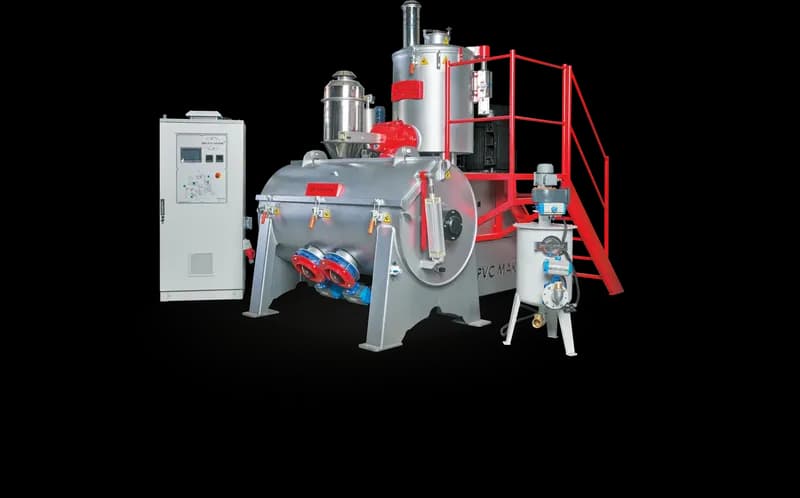
Gravimetric dosing is the most reliable way to hold the mass ratios of a PVC recipe batch after batch. Volumetric feeders are simple and inexpensive, but with powders of shifting density and multi-ingredient recipes, deviation is unavoidable. Erk PVC Makine plans, installs and commissions the dosing system together with the horizontal turbo PVC mixer or the vertical series.
Send us your raw material list and batch size, and request a quote for a dosing solution that fits your line.
Frequently Asked Questions
Is gravimetric dosing more accurate than volumetric?
When bulk density varies, yes. A gravimetric system measures mass directly, so density changes do not affect it, while a volumetric system assumes constant density.
What is the difference between batch weighing and loss-in-weight?
Batch weighing weighs each ingredient of a batch in sequence and discharges it to the mixer. A loss-in-weight feeder tracks its own weight loss to give a continuous flow. Hot-cold dry blend lines usually use batch weighing.
Can I convert a volumetric feeder line to gravimetric?
In most cases the line can be rearranged around a gravimetric weigh hopper. Feasibility depends on the mixer inlet, available height and raw material storage, assessed on site.
Can liquids be dosed gravimetrically too?
Yes. Plasticisers and liquid stabilisers can be dosed by weight, which stops temperature-dependent density and viscosity from upsetting the recipe.
What drives the price of a gravimetric dosing system?
The number of ingredients, storage type, batch size, need for liquid dosing and the scope of automation. Use the quote form for current pricing.