

Erk PVC Makine engineering teamUpdated:
What should the temperature profile of a PVC hot mixer look like?
Dry blend quality is decided along the temperature curve in the heating mixer. Here is what happens at each stage, how to set the discharge temperature and what makes cycles longer than they should be.

Contents10
- 1What is a hot mixer temperature profile?
- 2Stage by stage inside the heating mixer
- 3Choosing the discharge temperature
- 4How to estimate cycle time
- 5What makes cycles longer?
- 6How rigid and flexible profiles differ
- 7How speed control shapes the profile
- 8Why moisture extraction belongs in the profile
- 9How to monitor the profile
- 10Bottom line
What is a hot mixer temperature profile?
A hot mixer temperature profile is the temperature-versus-time curve that PVC resin and additives follow in the heating turbo mixer, from charging to discharge. No external heat is applied: the energy comes from friction generated by the high-speed impeller. The slope of the curve and the discharge point decide how well additives bond to the resin, how much moisture is driven off and what bulk density the dry blend ends up with.
For the bigger picture, start with our guide what is PVC dry blend. This article zooms in on the most critical step: what happens inside the heater.
Stage by stage inside the heating mixer
The ranges below are typical for rigid PVC formulations. Actual set points depend on the recipe, the stabiliser system and your additive supplier's guidance.
Stage | Typical temperature | What happens |
|---|---|---|
Charging and initial mixing | Ambient | Resin and main additives disperse; frictional heating begins |
Lubricants melt | about 60–80 °C | Waxes and lubricants soften and spread over the particle surface |
Particles open up | about 80–100 °C | Resin grains open their porous structure and take in additives |
Moisture leaves | around 100 °C and above | Moisture in resin and filler is released as steam |
Discharge | typically 110–125 °C | Additives are bonded; the batch drops into the cooler |
Plasticised (flexible) PVC adds one more stage in the middle: plasticiser absorption. The plasticiser is usually added once the resin has warmed up. Until it is absorbed the batch looks wet and sticky, then it turns free-flowing again. Discharging before this dry point almost always produces lumps.
Choosing the discharge temperature
The discharge point is a trade-off between quality and cycle time.
- Too low: shorter cycles, but additives may not be fully bonded, moisture can remain and plasticiser may not be completely absorbed. The usual result is low bulk density and poor flow.
- Too high: better bonding and moisture removal, but longer cycles, more energy per batch and a higher risk of discolouration in recipes with limited heat stability.
In practice the discharge temperature is found with trial batches for each recipe and then held constant. During formulation work, a laboratory mixer lets you run those trials without tying up the production mixer.
How to estimate cycle time
In a hot-cold mixer, heating and cooling run in parallel: while the cooler handles one batch, the heater works on the next. Line speed is therefore set by whichever of the two takes longer.
Converting batches per hour into minutes per batch is simple: 60 minutes divided by batches per hour.
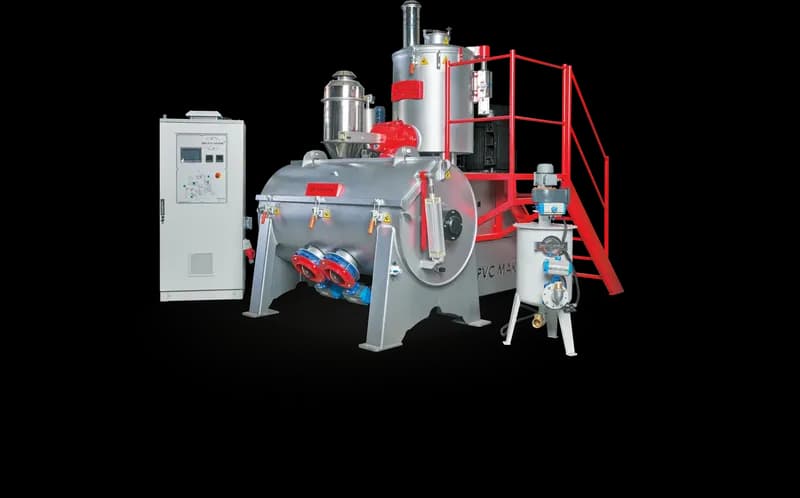
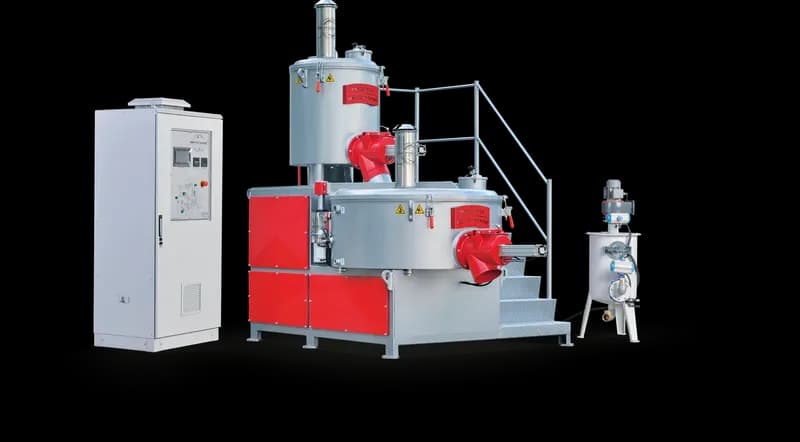
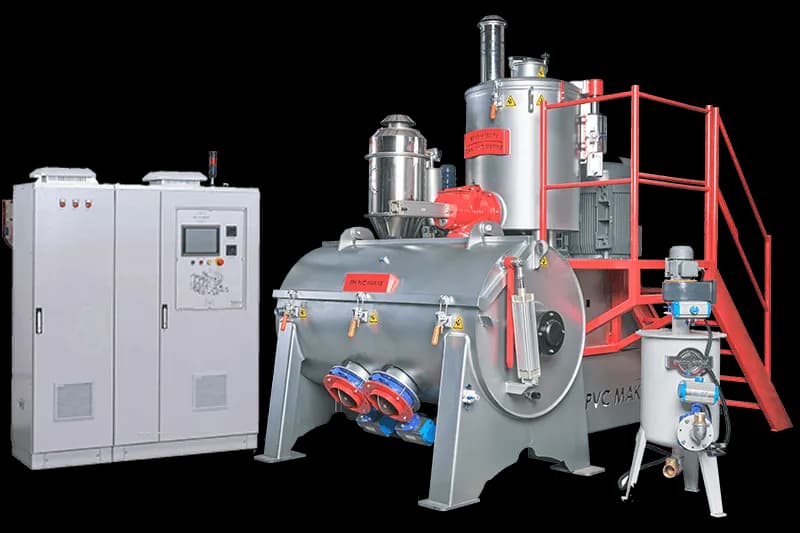
- The EPM-H horizontal turbo PVC mixer runs 4–6 batches per hour, which means roughly 10–15 minutes per batch.
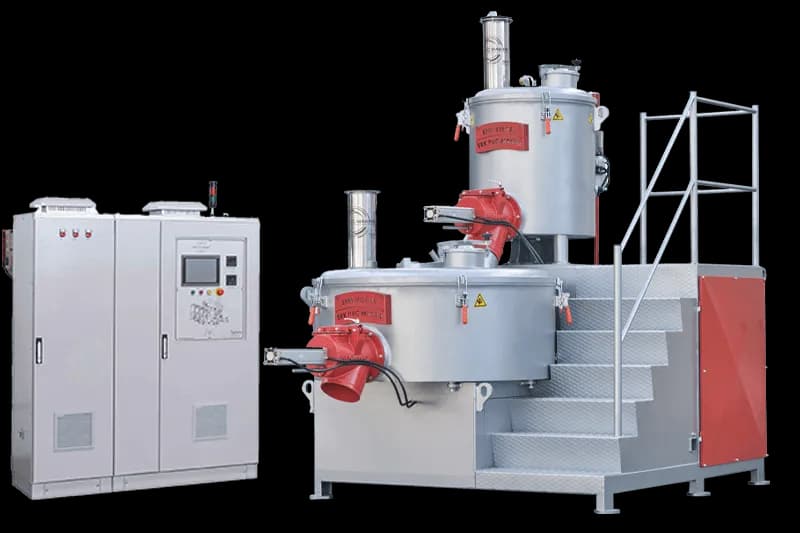
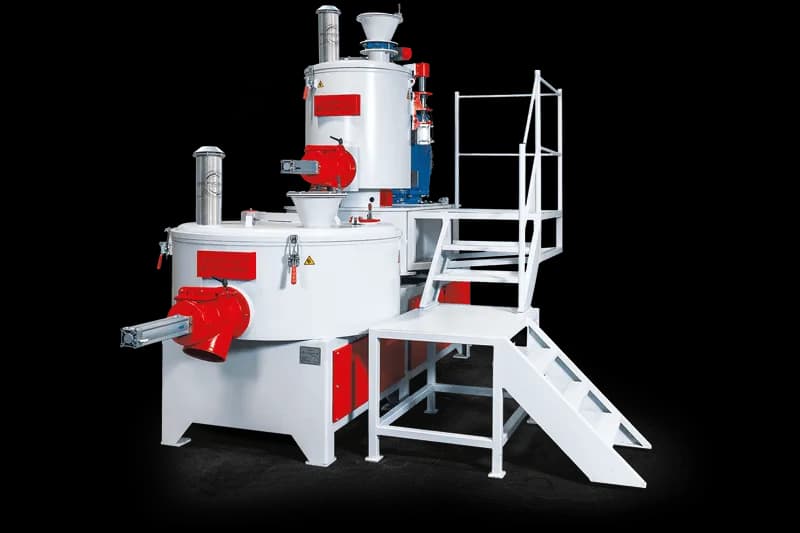
- The EPM-V vertical turbo PVC mixer runs 4–6 batches per hour, which means roughly 10–15 minutes per batch.
These are approximate ranges that depend on the formulation, and they include charging, discharge and transfer as well as the heating itself.
What makes cycles longer?
When cycles run longer than expected, the cause is usually one of these:
- Cooling water temperature. In summer, or when tower water warms up, the cooler becomes the bottleneck. The heater may be ready, but it cannot discharge until the cooler is empty.
- High filler content. More calcium carbonate changes how the batch heats and wears the impeller faster.
- Worn blades. A worn impeller moves material less effectively, so the batch takes longer to reach temperature. Inspect blades regularly and replace them with original mixer blades when needed.
- Fill level. Overfilling or underfilling the vessel disturbs the vortex the impeller relies on.
- Speed setting. On mixers with a frequency inverter (FV) the speed can be matched to each recipe. The wrong speed either slows heating or wastes energy.
- Moisture. Damp raw material spends energy on evaporation around 100 °C, so the steam has to be taken out of the mixer.
How rigid and flexible profiles differ
Rigid and flexible recipes can run on the same mixer, but their curves look different.
- Rigid PVC: the curve usually climbs smoothly and steadily. The key points are lubricant melting and the discharge temperature. Highly filled recipes heat differently, so the time needed to reach the same discharge point varies from recipe to recipe.
- Flexible PVC: the curve flattens noticeably when the plasticiser goes in. The liquid cools the batch slightly and changes how the impeller moves the material. Once absorption is complete and the batch is free-flowing again, the temperature climbs quickly. Here the discharge temperature is set separately, based on plasticiser level and supplier guidance.
The difference carries over to the impeller. Erk PVC Makine uses different blade geometries for rigid and flexible PVC because the material moves and heats differently in each. If your product mix has shifted from rigid to flexible recipes, it is worth asking whether the current impeller still fits.
How speed control shapes the profile
Impeller speed is the main lever on heating rate. Higher speed means more friction and faster heating, but not every stage needs full speed.
- During charging, lower speed reduces dusting and sudden motor load.
- During heating, high speed brings the batch to temperature in a reasonable time.
- During liquid addition, a speed that suits the recipe helps the plasticiser distribute evenly.
On mixers with a frequency inverter (FV) the speed is stepless, so each stage can be tuned to the recipe. On fixed-speed mixers the profile is managed mainly through fill level and discharge temperature. Either way, the goal is the same curve on every batch of the same recipe.
Why moisture extraction belongs in the profile
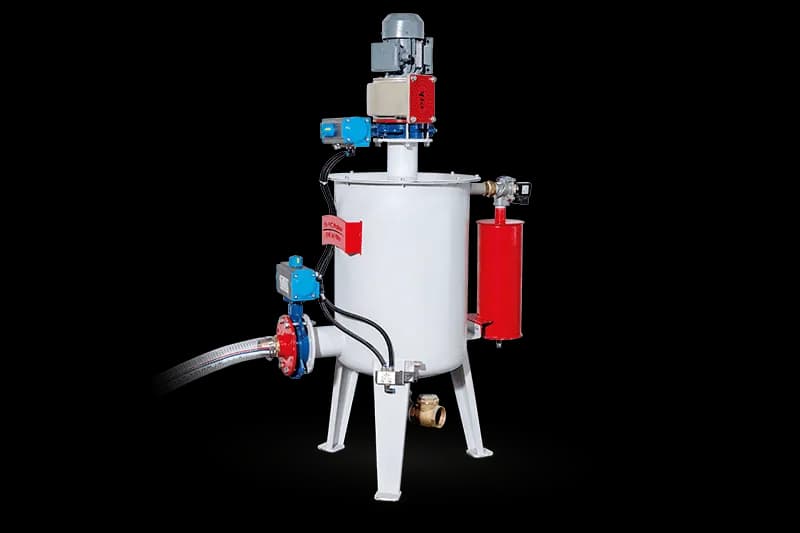
If the steam released during heating stays in the mixer, it condenses on the lid, drips back into the batch and causes lumps. The EPM-JET filter and dehumidifier extracts steam and dust during heating, so the part of the curve above 100 °C does its job of removing moisture from the blend.
How to monitor the profile
- Log temperature against time for every batch. If the slope changes for the same recipe, blades, fill level or raw material have probably changed.
- Discharge on temperature, not on time. A fixed timer carries ambient and raw material variation straight into the blend.
- Watch the cooler outlet too. A typical target is around 40–50 °C; dry blend stored warmer can cake in the silo.
- Change one thing at a time. Adjusting speed, fill level and discharge point together hides which change actually helped.
Bottom line
A good temperature profile is a repeatable one: same recipe, same curve, same discharge point. That comes from the right impeller, proper speed control, enough cooling capacity and effective moisture extraction. To review cycle time and capacity for your line, request a quote.
Frequently Asked Questions
What discharge temperature should a PVC hot mixer use?
For rigid PVC formulations the discharge is typically in the 110–125 °C range. The exact value is set with trial batches according to the recipe, stabiliser system and additive supplier guidance.
How long does one batch take?
At 4–6 batches per hour the EPM-H series works out at roughly 10–15 minutes per batch, and at 4–6 batches per hour the EPM-V series at roughly 10–15 minutes. Actual time depends on the recipe, target temperature and cooling water temperature.
Why do cycles get longer in summer?
Warmer cooling water slows the cooler down until it becomes the bottleneck. Even when the heater is ready, it cannot discharge until the cooler is empty.
Should I discharge on time or on temperature?
On temperature. A fixed timer passes variations in raw material moisture and ambient conditions directly into blend quality.
Do worn blades affect the temperature profile?
Yes. A worn impeller moves the material less effectively, so the batch reaches temperature later and the cycle stretches. A rising heating time is a good prompt to inspect the blades.