

Erk PVC Makine engineering teamUpdated:
In what order should additives go into a PVC mixer?
The same formulation gives a different dry blend depending on when each additive enters the hot mixer. Here are the typical sequences for rigid and flexible PVC, and the reasons behind them.

Contents11
- 1Why does the addition order matter?
- 2Typical sequence for rigid PVC
- 3Typical sequence for flexible (plasticised) PVC
- 4Making the sequence repeatable: dosing
- 5Pigments and coloured recipes
- 6Scaling up from lab to production
- 7Why temperature-triggered addition is more reliable
- 8Typical signs of the wrong sequence
- 9Moving from single charge to staged charging
- 10Practical tips
- 11Bottom line
Why does the addition order matter?
The PVC additive addition order defines at which stage, and at what temperature, the stabiliser, lubricants, filler, impact modifier, pigment and plasticiser enter the hot mixer. Order matters because each additive interacts with the resin particle at a different temperature, and some additives can get in the way of others reaching the resin. Getting it wrong shows up as low bulk density, lumps, weaker heat stability and unstable extrusion.
We cover the whole dry blend process in what is PVC dry blend. This article looks only at the sequence.
One caveat up front: the sequences below are typical industry practice. Your stabiliser and additive supplier's recommendation always comes first, and with one-pack stabiliser systems the sequence becomes much simpler.
Typical sequence for rigid PVC
Step | What goes in | Typical timing | Why |
|---|---|---|---|
1 | PVC resin + stabiliser | At charging | The stabiliser should protect the resin before it heats up |
2 | Internal lubricants, pigment (e.g. TiO2) | At or just after charging | They spread evenly over the particles as the batch warms |
3 | External lubricants and waxes | Early to mid heating | They melt and coat the particle surface |
4 | Impact modifier, processing aid | Mid heating, once the resin is warm | Added too early, they can slow additive uptake by the resin |
5 | Filler (calcium carbonate) | Mid to late heating | Added early, it pulls part of the stabiliser and lubricant onto its own surface |
6 | Discharge | typically 110–125 °C | Transfer to the cooler |
Many plants charge everything at once for practical reasons, and that can work. With highly filled recipes, though, adding the calcium carbonate later usually helps stabiliser and lubricant bond to the resin more efficiently.
Typical sequence for flexible (plasticised) PVC
In plasticised recipes, the critical question is when the liquid goes in.
- Charge resin and stabiliser and let the batch start heating.
- Add the plasticiser once the resin is warm. Pre-warmed resin absorbs plasticiser faster and more evenly. Adding it to cold resin increases the risk of lumps.
- Wait for absorption. The batch looks wet and sticky for a while, then turns free-flowing again. This is the dry point.
- Add filler and other powders after the dry point. Calcium carbonate added before the plasticiser is absorbed soaks up liquid on its surface and agglomerates.
- Discharge and cool.
How the liquid enters the mixer matters as much as when. Plasticiser poured quickly at a single point concentrates locally; a controlled, distributed feed reduces lump formation.
Making the sequence repeatable: dosing
Once the right order is written down, the real challenge is applying it the same way on every batch. On lines with manual weighing and charging, the sequence can drift between operators and shifts.
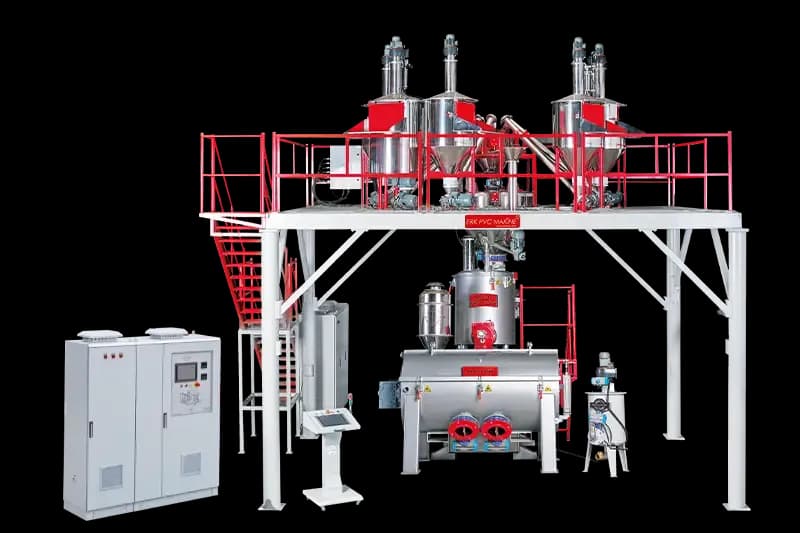
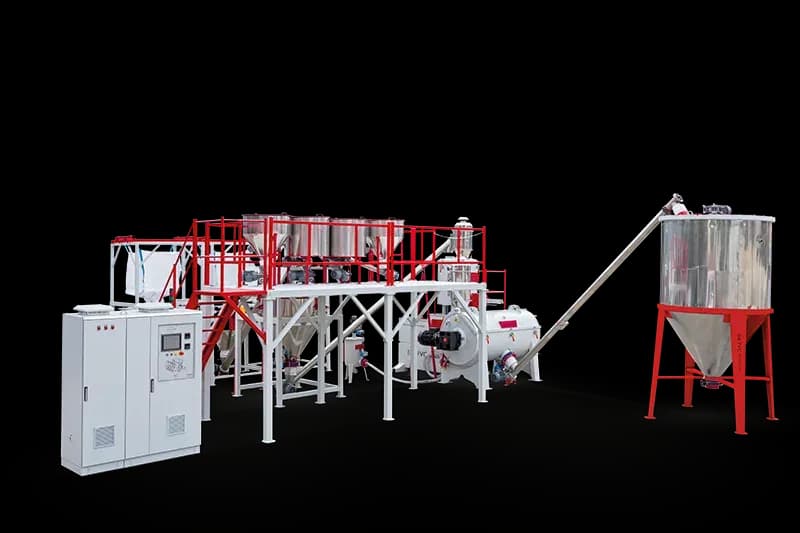
- An automatic powder dosing system weighs resin and powder additives gravimetrically to the recipe and standardises how the mixer is charged.
- An automatic liquid dosing system weighs plasticisers and liquid stabilisers gravimetrically and works together with powder dosing.
The order then depends on the system's recipe rather than on an operator's memory. For how the sequence ties into heating, see our article on the hot mixer temperature profile.
Pigments and coloured recipes
In coloured recipes, the point at which pigment goes in decides how consistent the shade is from batch to batch. White pigments such as titanium dioxide and colour pigments are usually added at charging, together with the stabiliser, so they spread evenly over the particles as the batch heats. With colour pigments used in small amounts, even a small weighing error shows up directly as a colour difference, so accurate weighing of minor components matters as much as the main ones. Some plants prepare small-quantity pigments and additives as a separate premix and charge it as a single component.
Scaling up from lab to production
Trialling a new sequence directly on the production mixer makes every bad batch expensive. During formulation work, addition points can be tested first on a small laboratory mixer. Heating rates and times are not the same in a lab mixer and a production mixer, though, so defining addition points by temperature rather than time scales up far more reliably. An instruction such as "add when the batch reaches a set temperature" means the same physical condition in both machines; "add at 60 seconds" does not.
Why temperature-triggered addition is more reliable
Time-based addition assumes every batch heats at the same rate. In reality raw material moisture, ambient temperature, blade wear and fill level all change the heating rate. Plasticiser added at the same second might meet resin at the right temperature in one batch and resin that is still too cool in the next. Tying addition points to temperature removes that variation, which is also why accurate, calibrated temperature measurement in the mixer matters.
Typical signs of the wrong sequence
- Low bulk density and poor flow: lubricant or stabiliser has gone onto the filler instead of bonding to the resin.
- Lumps: in flexible recipes, plasticiser was added to cold resin or together with the filler.
- Early yellowing: stabiliser went in late, or the batch heated before it was dispersed.
- Fluctuating extruder pressure and torque: additive distribution varies from batch to batch.
Moving from single charge to staged charging
Changing the sequence on a line that charges everything at once does not require a major overhaul. The most effective first step is usually to add the filler as a separate step later in the heating phase. For flexible recipes, the second step is adding plasticiser in a controlled way once the resin is warm. After each change, record bulk density, flow and colour for a few batches and move on only if the result is positive. That way you see exactly which change made the difference, without putting production at risk. The transition may require the dosing system to be configured for staged feeding.
Practical tips
- Write the addition order into the recipe sheet, by temperature or by step.
- When you change the order, run a few controlled batches and record bulk density, flow and colour.
- When switching to a new additive, ask the supplier for its recommended addition point.
- If an all-at-once line is having trouble, the first change to try is usually adding the filler later.
Bottom line
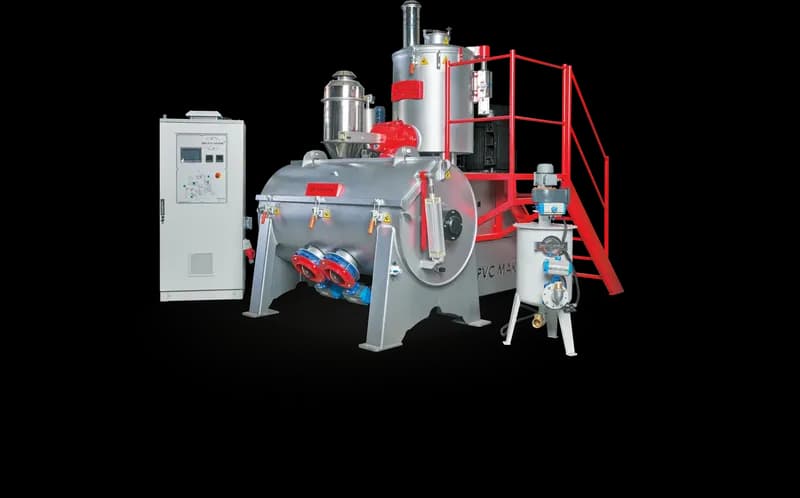
Addition order is one of the few settings that can improve dry blend quality without new investment. Applying it identically on every batch is much easier with automatic weighing and charging. If you are planning dosing automation for an EPM-H horizontal turbo PVC mixer or a similar line, request a quote.
Frequently Asked Questions
When should the stabiliser go into a PVC mixer?
In typical practice the stabiliser goes in with the resin at charging, so the resin is protected before heating starts. Your supplier's recommendation always takes priority.
Why is calcium carbonate added late?
Added early, calcium carbonate can draw part of the stabiliser and lubricant onto its own surface. Adding it later helps those additives bond to the resin, and the difference is clearest in highly filled recipes.
When should plasticiser be added?
Plasticiser is usually added after the resin has warmed up, because pre-warmed resin absorbs it faster and more evenly. Filler and other powders follow once the batch is free-flowing again.
Is it wrong to charge all raw materials at once?
Not always. Many recipes work with a single charge, especially with one-pack stabilisers. If you see lumps, low bulk density or poor flow, splitting the sequence is the first thing to try.
Can the addition order be automated?
Yes. Automatic powder and liquid dosing systems weigh each component to the recipe and standardise how the mixer is charged, so the order follows the recipe rather than the operator.