

Erk PVC Makine engineering teamUpdated:
What is a turbo mixer and how does it work?
A turbo mixer is the high-speed heating mixer that turns PVC resin and additives into free-flowing dry blend using frictional heat. Here is how it works, why it is paired with a cooler and what to look at when choosing one.

Contents8
What is a turbo mixer?
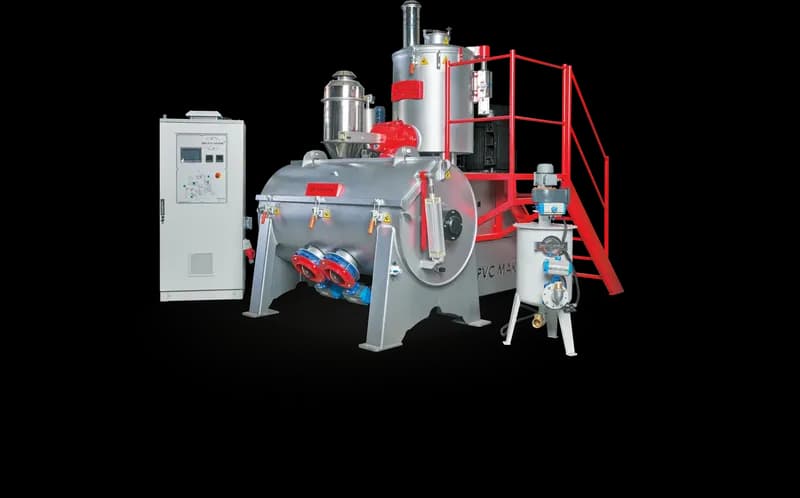
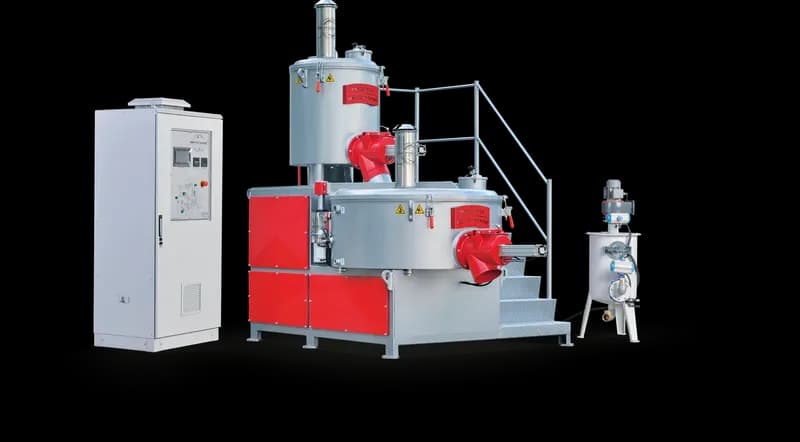
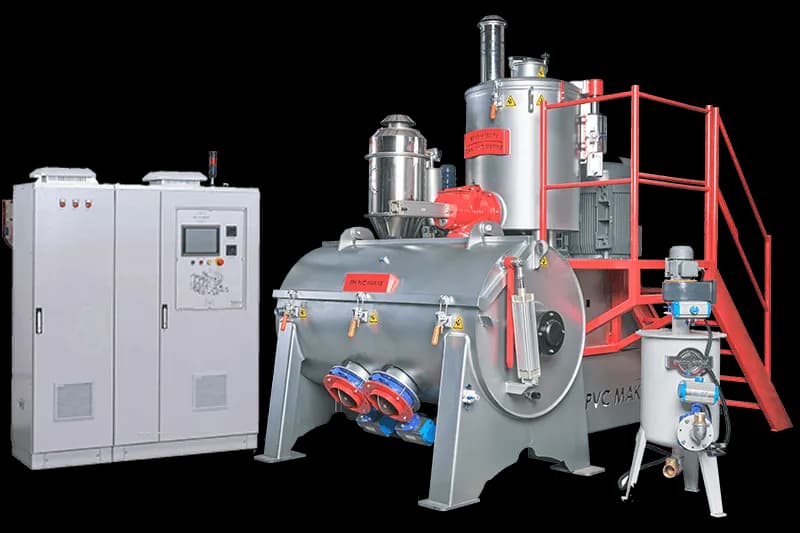
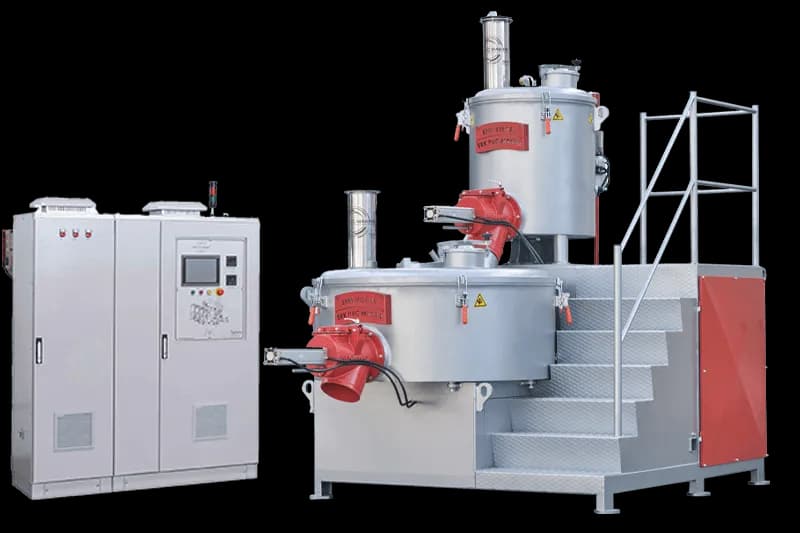
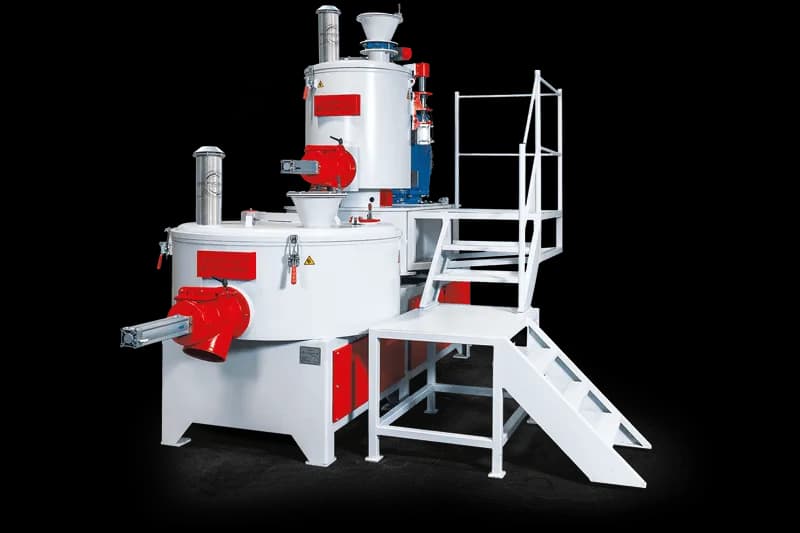
A turbo mixer is a high-speed heating mixer that blends PVC resin with its additives using a fast-rotating impeller and heats the batch through friction alone, with no external heater. Its job is not to grind the material or reduce particle size. It bonds stabilisers, lubricants, fillers and pigments onto and into the resin grains, producing dry blend: a dry, free-flowing powder. A turbo mixer almost always works together with a cooling mixer as a heating-cooling (hot-cold) mixer combination.
You will also see it called a high-speed mixer, hot mixer, heater mixer or PVC compounding mixer. They all refer to the same machine.
How does a turbo mixer work?
A multi-tier impeller sits near the bottom of the vessel. At high speed it throws the material up along the vessel wall, and the material falls back down the centre into the impeller. This constant circulation is the vortex. Particles rub against each other, the blades and the wall, and that friction heats the batch.
As the temperature rises, the batch goes through a predictable sequence:
- Dispersion: resin and powder additives are distributed evenly in the first minutes.
- Lubricants melt: waxes and lubricants soften and coat the grain surface.
- Grains open and bond: the porous resin grains open up and take in stabilisers and other additives.
- Moisture leaves: water in the resin and filler escapes as steam.
- Discharge: the batch is dropped into the cooler, typically at 110–125 °C, through a pneumatic discharge flap.
In flexible PVC, the plasticiser is added once the resin has warmed up; when it is fully absorbed, the batch becomes free-flowing again. For the stage-by-stage detail, read our guide to the hot mixer temperature profile.
Why does it need a cooler?
Hot dry blend dumped straight into a silo or bag cools slowly, cakes under its own weight and can lose some of the additive coating. So the batch from the turbo mixer goes into a cooling mixer: a slower-running vessel with a water-cooled jacket. There it is typically brought down to around 40–50 °C.
The real advantage of the hot-cold pair is that both halves work at the same time. While the cooler handles one batch, the heater is already working on the next. Line speed is set by whichever step takes longer.
Horizontal or vertical?
The heating mixer itself has a vertical shaft in both layouts. "Horizontal" and "vertical" usually describe the cooler body.
| Horizontal cooler (EPM-H) | Vertical cooler (EPM-V) |
|---|---|---|
Batch size | 150–500 kg | 100–200 kg |
Batches per hour | 4–6 | 4–6 |
Layout | Lower overall height, larger footprint | Smaller footprint, compact layout |
Typical use | High-output profile, pipe and cable lines | Mid-size lines, tight floor space |
We compare both layouts in more depth, including when each one makes sense, in horizontal vs vertical cooler mixer.
Where are turbo mixers used?
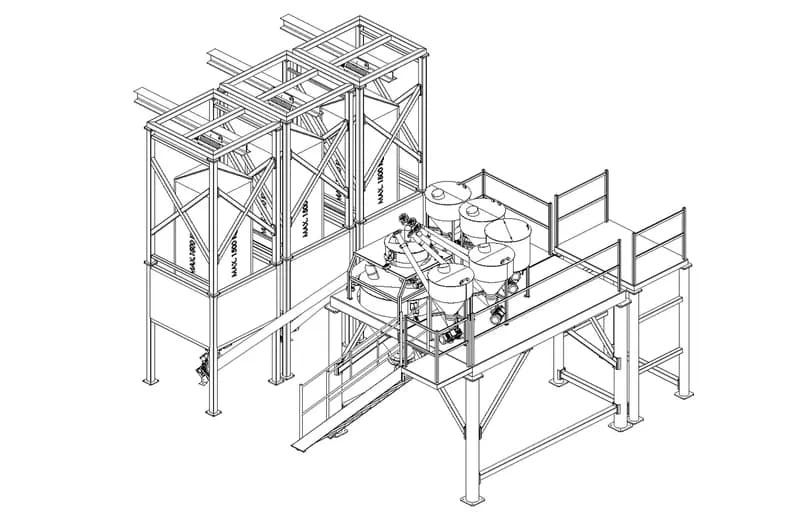
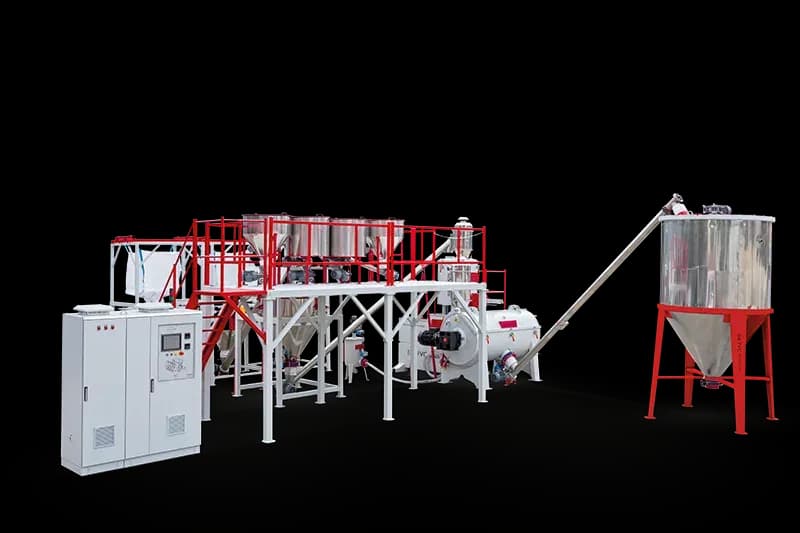
A turbo mixer sits at the start of almost every PVC processing line:
- PVC profile: rigid, often highly filled window and door profile recipes.
- PVC pipe: pressure and drainage pipe, fittings.
- Cable compound: plasticiser-rich sheathing and insulation recipes.
- Flooring, hose and film: flexible PVC formulations.
- Masterbatch: pre-mixing pigments and additives with a carrier, where even dispersion matters more than thermal bonding.
The recipe type drives the impeller choice. Erk PVC Makine uses different blade geometries for rigid and plasticised PVC, because the material moves and heats differently in each.
How to choose a turbo mixer
Four questions narrow it down:
- How much dry blend do you need per hour? Approximate hourly output is batch size × batches per hour. For the EPM-H series that works out at roughly 600–3000 kg/h, depending on the formulation. Our PVC mixer capacity calculation guide walks through the steps.
- Rigid or flexible recipes? High filler loadings and plasticised formulations change the impeller and drive selection.
- How much floor space and height do you have? This decides between a horizontal and a vertical cooler.
- How often do recipes change? On models with a frequency inverter (FV), speed can be matched to each recipe, which helps plants with frequent product changes.
For high-output lines, see the EPM-H horizontal turbo PVC mixer. For compact layouts, see the EPM-V vertical turbo PVC mixer. For formulation work and trial batches, a laboratory mixer is a separate option.
Common mistakes that hurt performance
- Over- or under-filling the vessel. The vortex breaks down, heating slows and the blend becomes less uniform.
- Discharging on a timer. Raw material moisture and ambient conditions vary, so a fixed time means a different end point each batch. Discharge on temperature.
- Running on worn blades. A worn impeller moves the material less effectively and heating takes longer.
- Leaving moisture in the mixer. Steam released during heating condenses on the lid and causes lumps if it is not extracted.
Bottom line
The turbo mixer is the first machine that decides quality on a PVC line. It does not grind the resin; it heats it together with the additives to produce a free-flowing, repeatable dry blend. With the right capacity, the right impeller and enough cooling, every batch comes out the same. To size a mixer for your line, request a quote.
Frequently Asked Questions
How is a turbo mixer different from an ordinary blender?
A turbo mixer runs at high speed and heats the batch by friction so that additives bond to the resin grains. Low-speed blenders only combine materials and give no thermal bonding.
Does a turbo mixer grind the material?
No. A PVC turbo mixer is not a mill or a rotor-stator machine. Its purpose is to bond additives onto and into the resin grains, not to reduce particle size.
What temperature does the batch reach?
For rigid PVC the discharge is typically in the 110–125 °C range. The exact point is set with trial batches according to the recipe and the additive supplier guidance.
Can a turbo mixer be used without a cooler?
Not for PVC dry blend. Hot blend stored directly will cake, which is why the turbo mixer runs as part of a hot-cold combination.
How many batches per hour does a turbo mixer run?
The EPM-H series runs 4–6 batches per hour and the EPM-V series 4–6. The actual number depends on the recipe, target temperature and cooling water temperature.