

Erk PVC Makine engineering teamUpdated:
How do you choose a flexible screw conveyor?
Material flow behaviour, feed rate, route, abrasion and level control at the hopper: the criteria that matter when you select a flexible screw conveyor for a PVC line, and what to send your supplier.

Contents11
- 1What is a flexible screw conveyor?
- 21. Know your material
- 32. Work out the real feed rate
- 43. Draw the route
- 54. Plan inlet and outlet
- 65. Do not forget level control
- 76. Wear and materials of construction
- 87. Cleaning and changeovers
- 98. Is a flexible screw always the answer?
- 10Quick checklist
- 11What to send Erk
What is a flexible screw conveyor?
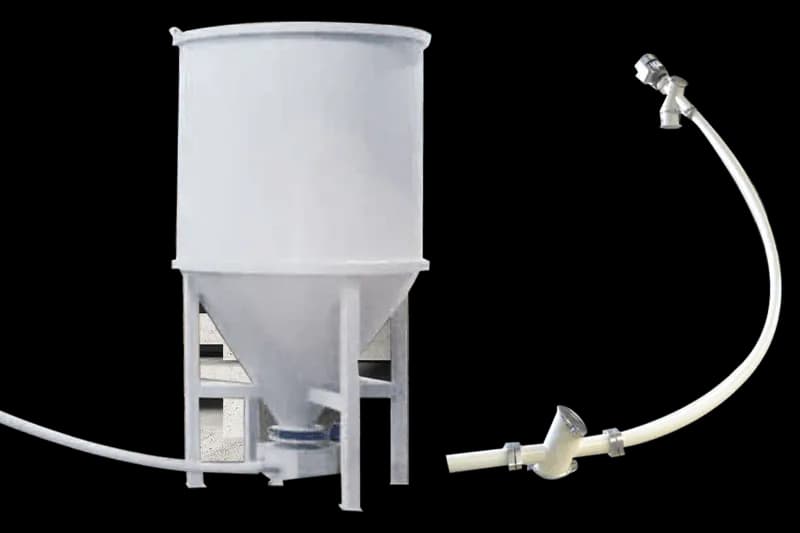
A flexible screw conveyor (often called a flexcon in Türkiye) is a closed conveyor that moves powder and granules with a shaftless spiral rotating inside a flexible tube. Because the tube can bend, the route follows the layout of the mixing room and material moves from one point to another without dust or spillage. On PVC lines its most common job is carrying dry blend from the silo or buffer hopper after the mixer to the extruder hopper.
It looks like simple equipment, but a poorly specified unit shows up quickly at the extruder: an unstable hopper level, bridging, segregation or wear far sooner than expected. The criteria below give you a structured way to specify one.
1. Know your material
Everything starts with the material. The same spiral behaves very differently in a fine powder and in granules.
- Flow behaviour: a free-flowing dry blend and a fine filler that tends to bridge cannot be conveyed with the same set-up. Bulk density and flowability influence spiral geometry and speed.
- Particle size: granules, powders and mixtures of the two may need different spiral and tube combinations.
- Abrasiveness: recipes with a high calcium carbonate content wear the spiral and tube faster.
- Temperature and moisture: blend that leaves the cooler too warm, or material that has picked up moisture, is more likely to stick and form lumps.
- Segregation risk: blends of components with different particle sizes and densities can separate on long, open routes.
If several materials share one conveyor, size it for the one that flows worst.
2. Work out the real feed rate
The conveyor must comfortably cover the actual consumption of the equipment it feeds. For extruder feeding, the benchmark is the extruder's highest throughput plus a margin that keeps the hopper level steady. If one conveyor serves several points, add up the combined demand.
Plan for the line you will run in the near future, not only today's output. That avoids a conveyor that is undersized within a year.
3. Draw the route
The route decides both performance and service life.
- Total length: a longer route means more load on the spiral and more wear. Shorter is always better.
- Horizontal and vertical sections: a flexible screw can combine both, but the share of vertical and inclined sections affects the feed rate.
- Bends: the tube is flexible, yet very tight bends increase friction and wear on the spiral. The number and radius of bends are reviewed during the project.
- Obstacles and access: when routing around platforms, beams and other machines, leave room for maintenance.
A simple layout sketch showing the position and height of each inlet and outlet is the single most useful thing you can send with an enquiry.
4. Plan inlet and outlet
What happens before and after the conveyor matters as much as the conveyor itself.
- Inlet side: the design of the silo outlet, buffer hopper or bag dump station keeps material flowing evenly into the spiral. A badly designed inlet hopper invites bridging.
- Discharge side: the connection to the extruder hopper, mixer or dosing bin must be dust-tight.
- Check screening: placing a powder sieve in the line to stop lumps reaching the extruder is common practice.
5. Do not forget level control
In extruder feeding the goal is a constant hopper level. This is usually achieved with level sensors in the hopper that start and stop the conveyor automatically. Without level control you risk either an overflowing hopper or a starved extruder. How the conveyor talks to your existing line controls should be settled at the selection stage.
6. Wear and materials of construction
With highly filled PVC recipes, wear is the main driver of a flexible screw conveyor's running cost. For these applications Erk PVC Makine uses wear-resistant special alloy steels and surface hardening. Service life still depends on the material and running hours, so regular inspection and a spare parts plan prevent unplanned stops.
7. Cleaning and changeovers
On lines with frequent colour or recipe changes, it matters how easily the conveyor can be emptied and cleaned. A flexible screw can be adjusted to different materials, which shortens changeover downtime, but cleaning access and the discharge point still need to be designed in from the start.
8. Is a flexible screw always the answer?
No. Flexible screw conveyors are strong in short to medium, closed, dust-free transfers at a steady rate. For very long routes, distribution from one source to many distant points, or very high throughputs, alternatives such as pneumatic conveying may suit better. On short, straight, fixed routes a rigid shafted screw (tubular or U-trough) can also be a good choice. The right answer depends on the material and the plant layout; for a detailed comparison see flexible or rigid screw conveyor?, and for throughput use the calculator in screw conveyor capacity calculation.
Quick checklist
Criterion | Question to ask |
|---|---|
Material | Powder or granules? How does it flow, is it abrasive? |
Feed rate | What is the peak consumption of the equipment fed? |
Route | Total length, vertical rise and number of bends? |
Inlet / outlet | Silo, buffer hopper or bag dump? Which hopper? |
Controls | How will level sensors and line controls connect? |
Wear | Calcium carbonate content and daily running hours? |
Changeovers | How often do colours or recipes change? |
What to send Erk
To specify the right conveyor with you, we need the material and recipe type, the equipment to be fed and its consumption, a layout sketch with inlet and outlet positions, and the number of extruders. Erk PVC Makine does not build extruders; we design the flexible screw conveyor that feeds them together with the dosing, mixing and sieving equipment, and manufacture it at our factory in Ergene, Tekirdağ. Installation, commissioning, operator training, remote support and spare parts are part of our scope.
Share your material and route, and we will prepare a quotation for your feeding system. You can also map the whole line in our line configurator.
Frequently Asked Questions
What is the main difference between a flexible and a rigid screw conveyor?
In a rigid screw conveyor the flight turns on a shaft and the route must be straight. A flexible screw conveyor turns a shaftless spiral inside a flexible tube, so the route can follow the layout, and the closed design keeps conveying dust-free.
How is the feed rate of a flexible screw conveyor chosen?
It must cover the peak consumption of the equipment it feeds, with a margin that keeps the hopper level steady. The flow behaviour of the material and any vertical sections on the route also affect the real feed rate.
How far can a flexible screw conveyor convey?
Distance depends on the material, the required feed rate and the horizontal and vertical sections of the route. Send us your layout and material and we will define the route and conveyor size with you.
Do flexible screws wear quickly with highly filled recipes?
Wear increases with calcium carbonate content. Erk uses wear-resistant special alloy steels and surface hardening for these applications, but service life still depends on running hours, so regular inspection is recommended.
Can one flexible screw conveyor feed several extruders?
Usually each extruder hopper gets its own conveyor, all fed from a shared silo or buffer hopper. The mixer must cover the combined consumption of all extruders.