

Erk PVC Makine engineering teamUpdated:
Flexible or rigid screw conveyor? Which one, and when?
Both convey powder and granules, but one is strong on curved routes and the other on straight, high-throughput lines. The differences, where each fits in a PVC line and a decision checklist.
Contents8
How the two systems work
In a rigid screw conveyor the flight sits on a central shaft and turns inside a fixed casing. The casing can be a tube (tubular screw conveyor) or a covered trough (U-trough screw conveyor). The shaft is carried by bearings at both ends.
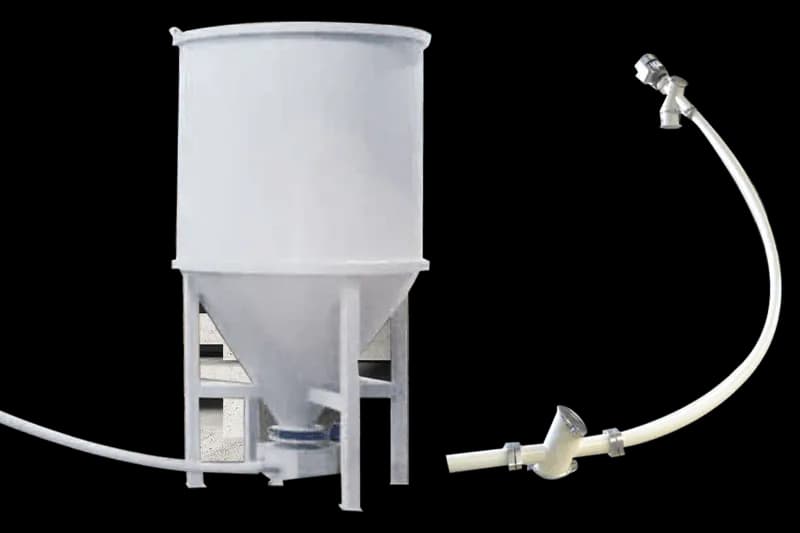
In a flexible screw conveyor (Flexcon) there is no central shaft. A spiral turns inside a flexible tube, usually driven from the discharge end. Because the tube can bend, the route can go around obstacles.
Comparison table
Criterion | Flexible screw | Rigid screw (tubular / U-trough) |
|---|---|---|
Route | Can curve around obstacles | Straight and fixed |
Horizontal and vertical | Can be combined in one line | Separate conveyors or a special design per section |
Throughput | Suited to feeding over short and medium distances | Strong on high-throughput transfers |
Dust tightness | Closed tube, dust-free | Tubular closed; U-trough covered |
Cleaning | Spiral removed for cleaning | Easy access through the cover on U-trough |
Wear | Spiral and tube wear and are replaced | Flight, casing and bearings wear |
Layout changes | Adapts easily | The conveyor may have to change |
Typical job | Buffer hopper to extruder hopper and mixer feeding | Below silos, between hoppers, collecting and distributing |
Which for PVC dry blend and filled recipes?
Both types convey PVC dry blend. What decides is the material’s behaviour and the job:
- Feeding dry blend to the extruder: a flexible screw conveys enclosed and as a mass, so the blend does not segregate or raise dust; it is practical on short, curved routes.
- Highly filled recipes: calcium carbonate is abrasive. In a flexible screw the spiral and tube wear; in a rigid screw the flight and casing. For both, wear-resistant options are assessed for the material; Erk uses wear-resistant special alloy steels and surface hardening on flexible screws.
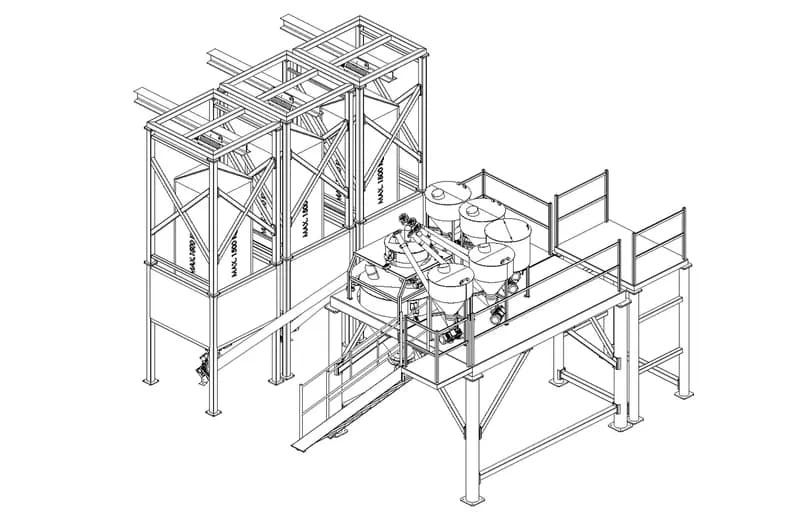
- High throughput below a silo: for taking raw material from a silo to dosing or the next machine, the tubular screw conveyor leads.
Choosing for extruder hopper feeding
The extruder hopper is usually high up and surrounded by other equipment. The route from buffer hopper to extruder hopper often combines horizontal and vertical sections, which is why flexible screws are common for hopper feeding. The screw works with level control on the hopper to keep the level steady. Flexible screw selection is covered in detail in how to choose a flexible screw conveyor.
Long lines and high throughput
As the route gets longer and throughput rises, the load on a flexible screw and its wear increase. For very long, high-throughput transfers a rigid screw, a chain conveyor or pneumatic conveying may suit better. The limit is not a fixed number: it is assessed from the material, the throughput and the horizontal and vertical sections of the route.
Where does vacuum conveying fit?
Pneumatic (vacuum) conveying leads on long routes with many points and when feeding several destinations from one source, although dry blend can segregate in dilute phase. See vacuum conveying of powders.
Decision checklist
- Is the route straight or curved? Are there horizontal and vertical sections?
- What is the hourly throughput, including future growth?
- Is the material abrasive, hygroscopic or prone to segregation?
- Could the line layout change later?
- How often do cleaning and recipe changes happen?
- Does the line feed one point or several?
With these answers we choose the right type with you. To work out throughput with your own figures, use the calculator on our screw conveyor capacity calculation page.
Erk builds both
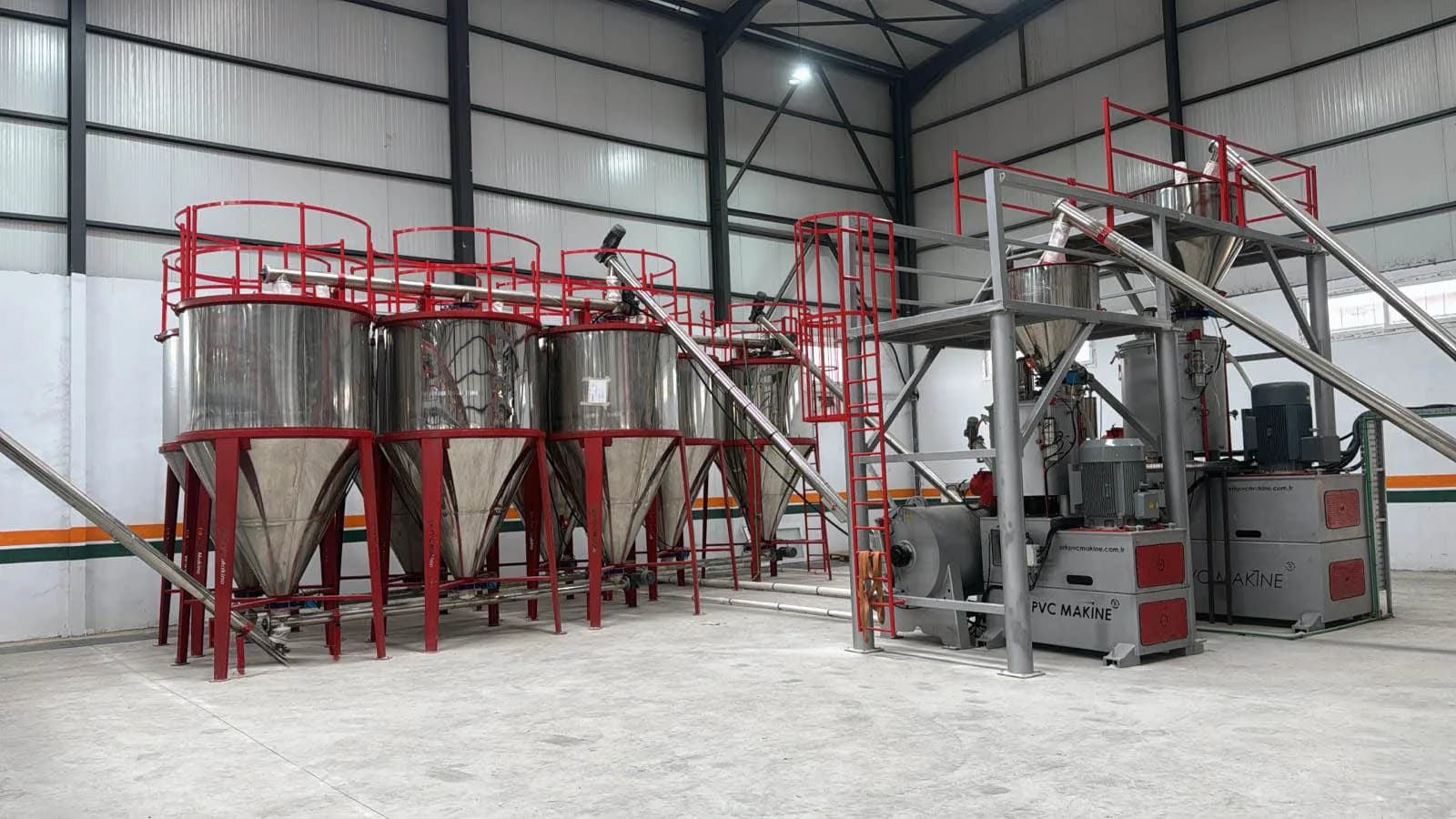
Erk PVC Makine builds flexible, tubular and U-trough screw conveyors and the screw feeder in its own factory. So our recommendation is not tied to one product; we choose the right type for each point in your line. All types are compared in types of screw conveyors.
Frequently Asked Questions
What is the main difference between a flexible and a rigid screw conveyor?
In a rigid screw the flight turns on a shaft in a fixed casing and the route is straight. In a flexible screw a shaftless spiral turns in a flexible tube; the route can curve and horizontal and vertical sections can be combined in one line.
Which is better for feeding an extruder hopper?
Flexible screws are common for hopper feeding because the route often combines horizontal and vertical sections. The final choice depends on throughput, material and layout.
Which is preferred for high throughput?
On straight, high-throughput transfers, especially below silos, the rigid (tubular) screw leads. On very long routes with many points, chain conveyors or pneumatic conveying are also considered.
Which screw conveyor types does Erk build?
Erk builds flexible, tubular and U-trough screw conveyors and screw feeders in its own factory; its screws are used in PVC lines and in other industries.