

Mixers and Dosing for Masterbatch Production
From pigment premix to granule blending: the equipment before and after your masterbatch extruder.

Erk PVC Makine designs and installs mixing, dosing and feeding systems for masterbatch production. The compounding extruder that actually disperses the pigment, and the pelletiser, come from other suppliers; we supply the dosing, premixing and feeding steps in front of the extruder, plus granule sieving and blending after it, and we work with any extruder brand.
Masterbatch blend requirements
Colour and additive masterbatches are made by loading a carrier resin with a high share of pigment or additive. A typical formulation combines a carrier resin (powder or granule) with organic or inorganic pigments, fillers, dispersing aids and waxes, and functional additives such as UV stabilisers, antistatics or slip agents.
Final dispersion happens in the compounding extruder, but a homogeneous premix going into the extruder is the precondition for it. If pigment and carrier are not evenly mixed, extruder feeding fluctuates, the shade drifts and granules show streaks. Masterbatch producers also change colour many times a day, so cleanability matters as much as mixing quality.
Recommended line steps
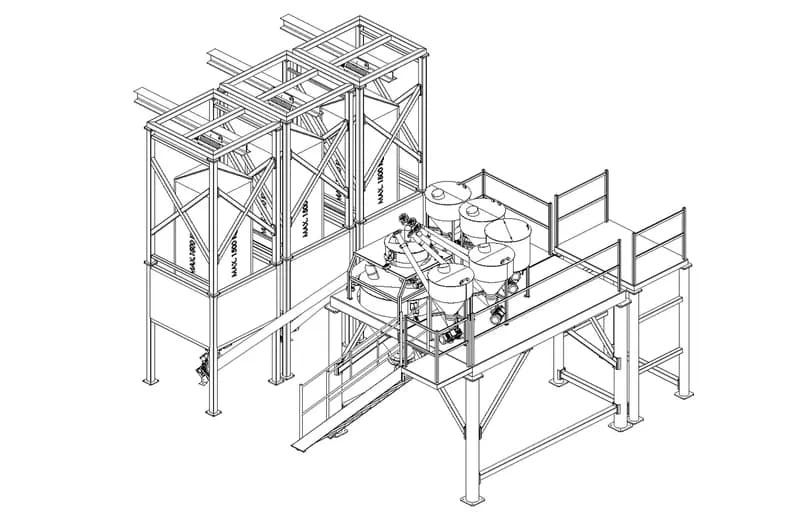
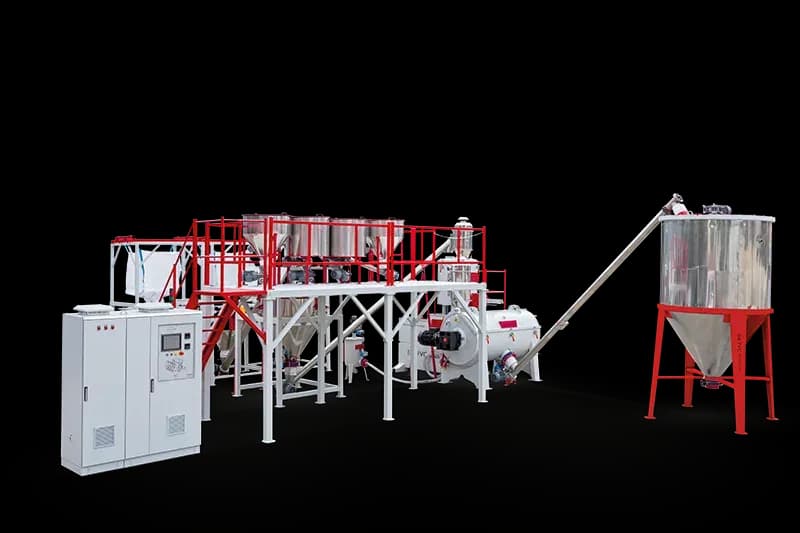
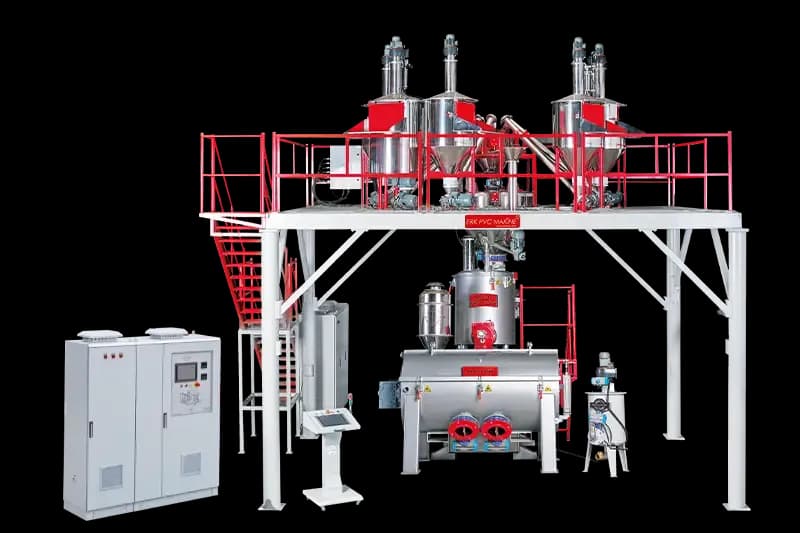
- Dosing: Carrier resin, pigments and powder additives are weighed to the recipe by the automatic powder dosing system.
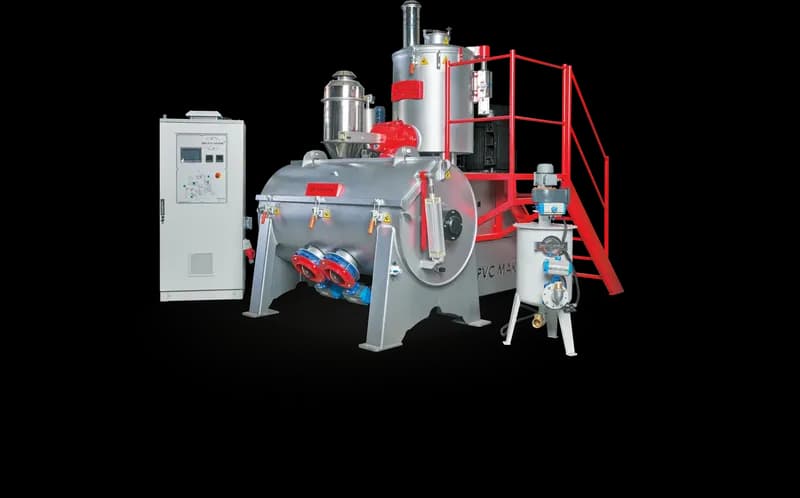
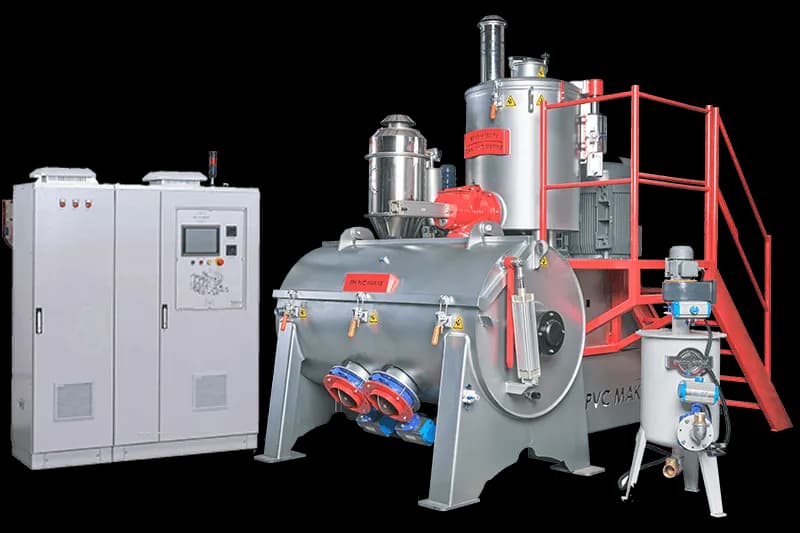
- Premixing: The components are homogenised in a ribbon blender, designed for powder and granule blends that do not need high speed. Optional liquid spray adds liquid additives, and side choppers help break up agglomerates.
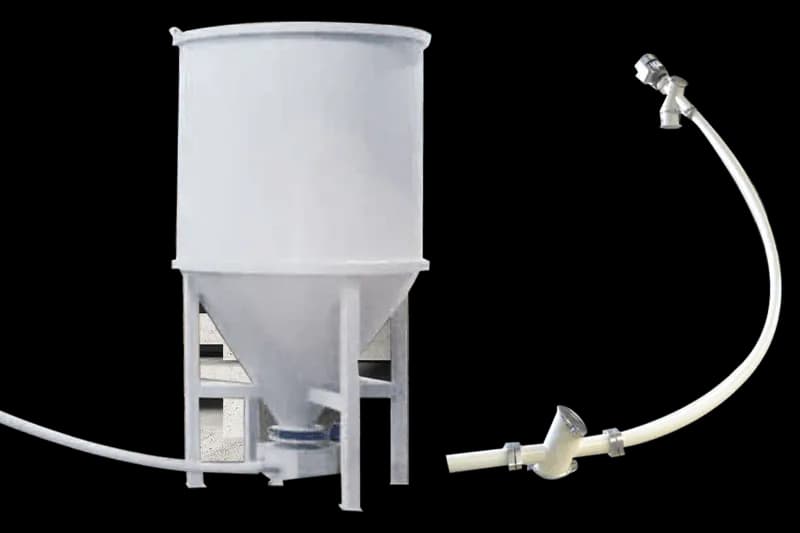
- Feeding: A flexible screw conveyor carries the premix, enclosed and dust-free, to the compounding extruder hopper.
- Granule sieving: Product from the pelletiser passes a granule sieve that removes oversize and fines.
- Lot blending: Sieved granules are blended at low speed in a vertical blender to build uniform lots and prevent segregation.
Recommended equipment
Line step | Erk equipment | Why |
|---|---|---|
Raw material weighing | The same recipe for pigments and additives in every batch | |
Premixing | Low-speed, homogeneous blending of powders and granules; removable blades | |
Extruder feeding | Enclosed, dust-free conveying | |
Granule control | Separates oversize and fines | |
Granule blending | Prevents segregation and keeps silos flowing | |
Colour trials | New shades and formulation development |
The ribbon blender is available in carbon or stainless steel, with single-speed, two-speed or frequency inverter (FV) drives. Centre or side discharge is chosen to suit your layout and cleaning routine.
Quality factors
- Pigment dispersion: a homogeneous premix makes dispersion in the extruder easier and reduces shade variation.
- Colour change: removable blades and the right discharge design give easier access to internal surfaces between colours.
- Materials of construction: a stainless steel body reduces the risk of contamination in light shades and sensitive applications.
- Dust control: enclosed dosing and conveying limit pigment dust spreading into the plant and into other colours.
- Lot consistency: granule sieving and blending make sure every lot you ship has the same granule size and the same shade.
Sizing example
Example: Assume a hypothetical masterbatch plant with 2 compounding extruders, each consuming about 250 kg/h of premix. The figures are assumptions, not customer data.
- Total consumption: 2 × 250 = 500 kg/h
- With a 20% margin: about 600 kg/h
- Batch size: assuming 3 premix batches/h, about 200 kg/batch
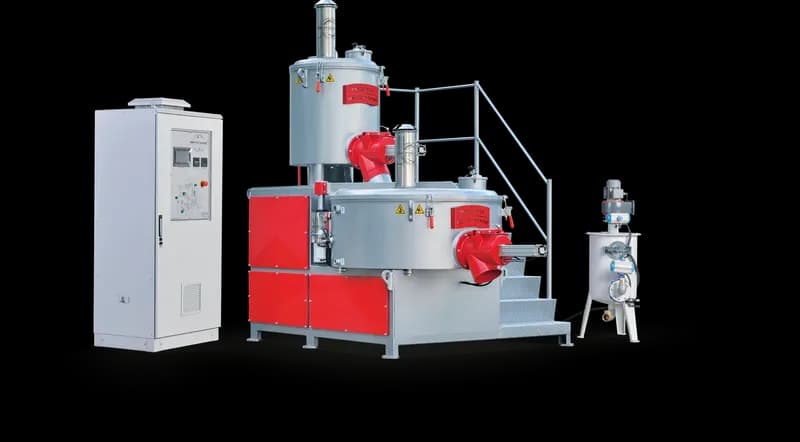
Masterbatch premix does not need a hot-cold process, so the EPM-H (about 600–3000 kg/h) and EPM-V (about 400–1200 kg/h) hot-cold series are not the reference here; the premix is made in a ribbon blender whose volume is chosen per project from the batch size and colour-change frequency. With frequent colour changes, smaller and more frequent batches make cleaning easier. The line also includes powder dosing, flexcon screw conveying, a granule sieve and a vertical blender sized to the lot size.
To run the numbers for your own plant, use the capacity calculator or send us your data via the quote page.
What Erk supplies and what other suppliers supply
Erk PVC Makine does not build extruders. The compounding extruder and pelletiser come from the supplier of your choice. We supply the dosing, premixing, feeding, sieving and granule blending equipment — manufactured at our factory in Ergene, Tekirdağ (head office in Istanbul) — together with installation, commissioning, operator training, remote support and spare parts. Our line connects to your existing or new extruder, whatever the brand.
For related premixing and sieving needs, see cable compound and powder coating.
Request a line layout
Send us your formulations, number of colours and target hourly output, and we will send you a line layout with an equipment list. To put your line together step by step, you can also use our line configurator.
To receive a line layout and quotation for your masterbatch line, request a quote.
Products

Frequently Asked Questions
Which mixer size do I need for my masterbatch output?
Mixer size depends on your hourly extruder output, how often you change colour and whether the carrier resin is powder or granule. Lines with frequent colour changes benefit from a smaller, easy-to-clean premixer, while long single-colour campaigns favour a larger one. We choose the right size with you based on your formulations and output.
What is a typical masterbatch formulation and dosing order?
A typical formulation contains carrier resin, pigments, fillers, dispersing aids and waxes, plus functional additives where needed. The carrier resin usually goes in first, followed by pigments and powder additives; any liquid additive is added through the ribbon blender’s optional liquid spray. The exact order is set with you during commissioning.
Can your line feed my existing compounding extruder (any brand)?
Yes. Erk PVC Makine does not build extruders, so our dosing, premixing and feeding line is engineered to connect to any brand of compounding extruder. The feed point and layout are planned around your existing plant.
How do you improve pigment dispersion and shorten colour change and cleaning time?
We turn pigment and carrier resin into a homogeneous premix in a ribbon blender before the extruder, with side choppers helping to break up agglomerates. For colour changes, removable blades, a centre or side discharge and a stainless steel body make internal surfaces easier to reach and clean. Enclosed dosing and flexible screw conveying limit pigment dust carrying over into other colours.
Do you supply the full line from raw material dosing to granule blending?
Yes. We supply powder dosing, premixing, extruder feeding, granule sieving and lot blending in a vertical blender from one source, and we handle installation and commissioning. The compounding extruder and pelletiser come from the supplier you choose.
Request a Quote
Fill in the form and our sales engineers will get back to you within one business day.